
Buying a home is one of the biggest financial decisions many people make. It is not only about finding a beautiful apartment or house. A good home should also fit your budget, daily lifestyle, future plans and financial comfort.
Many home buyers make the mistake of looking at properties first and thinking about their budget later. A better approach is the opposite: understand your budget first, define your needs, research locations, compare properties, and then make a decision.
This guide explains how to find a residential property that offers good value without putting unnecessary pressure on your finances.
Important: This article is for general information and educational purposes. Property rules, taxes, registration charges, loan terms and local regulations can vary by state and property type. Always verify important details with the relevant government authority, lender and qualified legal or financial professional before making a property purchase.
Quick Summary
Finding the right residential property starts with knowing what you can comfortably afford.
The main steps are:
- Calculate your total home-buying budget.
- Keep money aside for emergencies.
- Do not look only at the property’s advertised price.
- Include registration, stamp duty, taxes, maintenance, interiors and other applicable costs.
- Decide whether you need a ready-to-move, resale or under-construction property.
- Choose the location according to your daily needs.
- Compare several properties instead of choosing the first one you like.
- Check the project’s RERA registration where applicable.
- Verify property documents before paying a large amount.
- Compare home-loan interest rates, fees and repayment terms.
- Inspect the property carefully.
- Check water, electricity, roads, public transport and other facilities.
- Think about your future needs, not only your current requirements.
- Take independent professional advice when the transaction is legally or financially complicated.
The best property is usually not the most expensive property you can qualify for. It is the property you can afford comfortably while still maintaining a healthy financial cushion.
Key Pointers for Home Buyers
Before property hunting
- Set a maximum total budget.
- Calculate your available savings.
- Decide how much you can comfortably pay every month.
- Keep an emergency fund separate.
- Check your existing loans and financial commitments.
- Make a list of your essential requirements.
While comparing properties
- Compare the total cost, not only the base price.
- Check the location and connectivity.
- Visit the property at different times of the day.
- Check construction quality and common areas.
- Ask about maintenance and other recurring charges.
- Compare at least three to five suitable properties.
Before booking
- Check RERA information where applicable.
- Read the agreement carefully.
- Verify ownership and other important documents.
- Understand the payment schedule.
- Check the possession timeline for under-construction properties.
- Do not make a decision only because of a limited-period sales offer.
1. Start With Your Real Budget
The first question should not be, “Which house do I like?”
The first question should be:
“How much can I safely spend on a home?”
Your property budget should consider your income, savings, existing loans, regular expenses, emergency needs and future financial goals.
For example, suppose a family has savings of ₹20 lakh. That does not automatically mean the entire ₹20 lakh should be used as the down payment.
Some money may be needed for:
- Emergency savings
- Moving expenses
- Registration and transaction-related costs
- Basic furniture
- Repairs
- Appliances
- School or education expenses
- Medical or family needs
- Unexpected expenses
A financially comfortable purchase is better than using almost all your savings to buy a bigger house.
A simple budgeting approach
Create three separate amounts:
1. Property fund:
Money available for the purchase and related costs.
2. Emergency fund:
Money kept aside for unexpected situations.
3. Regular-life fund:
Money needed for monthly household expenses and other important goals.
This approach helps prevent a situation where the buyer becomes “house rich but cash poor.”
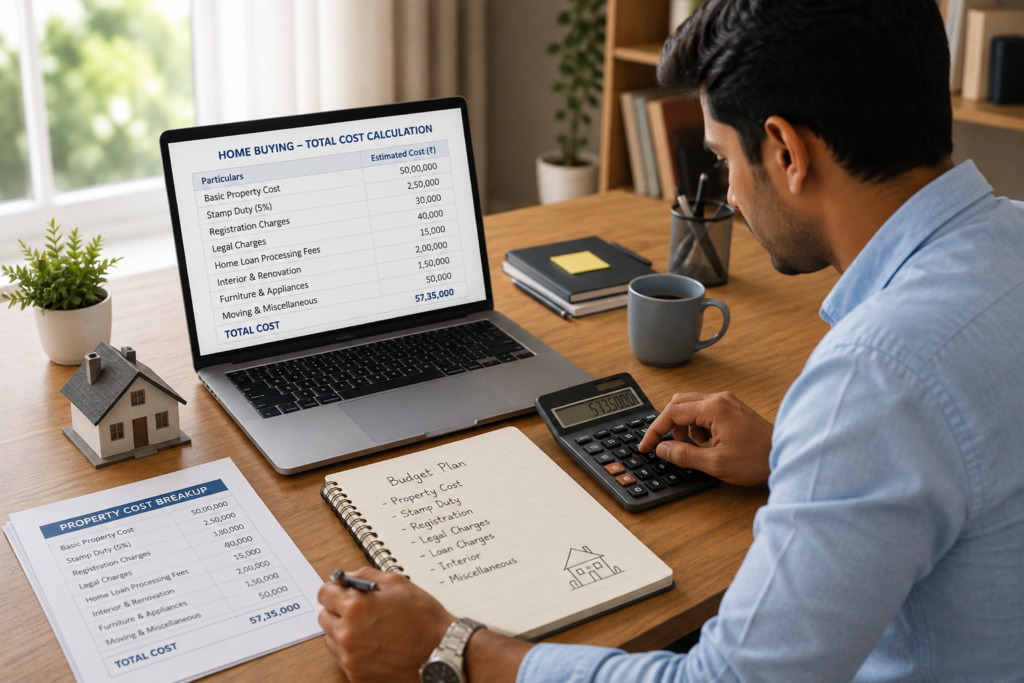
2. Understand the Difference Between Property Price and Total Cost
One of the most common mistakes made by first-time buyers is looking only at the advertised property price.
A property advertised at ₹60 lakh may require additional expenses depending on the transaction and location.
Possible costs can include:
- Stamp duty
- Registration charges
- Applicable taxes
- Brokerage, if any
- Legal verification
- Loan processing or related charges
- Maintenance deposits
- Society or association-related charges
- Parking charges, where applicable
- Interior work
- Furniture and appliances
- Moving expenses
- Repairs or upgrades
The exact charges vary according to the state, property, transaction and applicable rules.
Therefore, before deciding that you can afford a property, ask the seller or developer for a complete cost sheet.
Ask this simple question:
“What is the total amount I will need to pay from booking to possession?”
Get the answer in writing.
3. Decide How Much EMI You Can Comfortably Handle
If you plan to use a home loan, do not decide the loan amount only on the basis of what a bank is willing to lend.
A lender evaluates your repayment capacity according to its own criteria. Your personal comfort level may be different.
Consider:
- Monthly income
- Existing EMIs
- Household expenses
- School or education expenses
- Insurance
- Savings
- Future financial goals
- Possible changes in income
- Interest-rate changes for floating-rate loans
A floating-rate loan can change over time. The Reserve Bank of India explains that floating home-loan rates can change with market interest rates, which can affect repayment through higher EMIs, longer tenure or both.
Therefore, buyers should understand the interest-rate structure, benchmark, reset conditions, fees and other important terms before signing the loan agreement.
Do not forget the long-term cost
A home loan is not just the monthly EMI.
Look at:
Loan amount + total interest + applicable fees = overall borrowing cost
Ask the lender for an amortisation or repayment schedule so you can understand how the loan works over time.
4. Make a List of Your Needs Before Looking at Properties
Property searching becomes confusing when every attractive feature starts looking “necessary.”
Make two lists:
Must-have features
These are features you do not want to compromise on.
For example:
- Two or three bedrooms
- Safe access
- Reasonable travel time to work or school
- Reliable water supply
- Adequate ventilation
- Lift, if required
- Parking, if genuinely necessary
- Suitable floor preference
Nice-to-have features
These are features you would enjoy but can live without.
Examples:
- Large clubhouse
- Extra balcony
- Premium flooring
- Fancy lobby
- Swimming pool
- Bigger gym
- High-floor apartment
This simple exercise can prevent you from spending significantly more for features that are not essential.
5. Choose the Right Location
A good home in the wrong location can become difficult to enjoy.
Before choosing a property, study the surrounding area.
Look at:
- Distance from workplace
- Schools and colleges
- Hospitals and clinics
- Grocery stores
- Public transport
- Main roads
- Metro or railway connectivity where relevant
- Parks and recreational spaces
- Banks and ATMs
- Restaurants and daily-use services
- Traffic conditions
- Water availability
- Drainage and flooding concerns
- Noise levels
- Future infrastructure plans
Do not judge a neighbourhood only from a sales brochure.
Visit it yourself.
Try visiting during:
- Morning
- Afternoon
- Evening
- Weekend
A road that looks quiet at 11 a.m. may be very busy during office hours.

6. Compare Different Types of Residential Property
Home buyers generally come across different options, such as:
Ready-to-move property
The property is completed and may allow the buyer to inspect the actual home and surrounding facilities.
Possible advantages:
- You can see the finished property.
- You can inspect construction and common areas.
- You may be able to move in sooner.
Possible disadvantages:
- The upfront price may be higher in some locations.
- Older properties may require renovation.
- Maintenance and building condition need careful inspection.
Under-construction property
The buyer purchases a property that is still being developed.
Possible advantages:
- Payment may be spread according to the construction/payment schedule.
- Buyers may have access to newer developments and amenities.
Possible risks:
- Construction delays
- Changes during development
- Future maintenance costs
- Difference between expectations and final delivery
Always check the project’s regulatory status and documents before committing.
Resale property
A resale property can sometimes offer an opportunity to live in an established neighbourhood.
However, check:
- Ownership history
- Existing loans or charges
- Maintenance dues
- Property condition
- Society records where relevant
- Required approvals and documents
- Applicable transfer and registration requirements
7. Check RERA Registration Where Applicable
The Real Estate (Regulation and Development) Act, 2016 was introduced to improve transparency and protect the interests of real-estate consumers.
The Ministry of Housing and Urban Affairs explains that real-estate projects covered by the Act generally need registration with the relevant State or Union Territory Real Estate Regulatory Authority before being offered for sale, subject to the Act and applicable exemptions. The Ministry also provides links to State and UT RERA authorities.
RERA information can help buyers examine details such as:
- Project registration
- Promoter information
- Project status
- Declared completion information
- Approved plans and other uploaded documents, where available
- Complaint-related information, where published
The Ministry states that RERA also requires 70% of amounts collected from buyers for applicable projects to be deposited in a separate bank account for construction and land costs, subject to the Act and its rules.
Important point
RERA registration does not mean that a property automatically suits every buyer.
You should still perform your own financial, technical and legal checks.

8. Verify Important Property Documents
Property documentation is one area where buyers should not depend only on verbal promises.
Depending on the property and state, relevant documents can include:
- Title documents
- Sale deed or previous ownership documents
- Encumbrance-related records
- Approved building plans
- Completion or occupancy-related documents, where applicable
- Property tax records
- RERA registration details, where applicable
- Loan or mortgage-related information
- Society or association documents
- Utility-related records
- Other local approvals
The exact documentation required can vary.
For a significant purchase, consider having the documents reviewed by an independent property lawyer.
Do not rely only on documents supplied by a salesperson if you are unsure about their legal meaning.
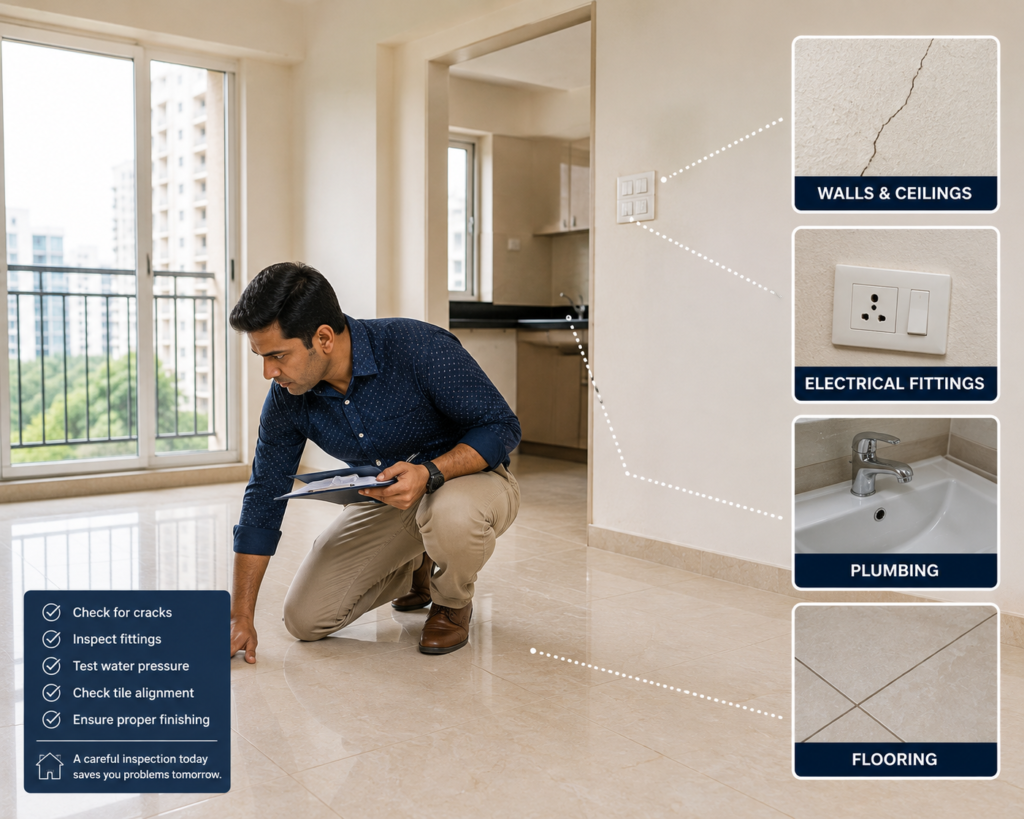
9. Inspect the Actual Property
Photographs can make almost any home look attractive.
That is why an actual property visit is important.
During your inspection, look at:
Walls and ceilings
Check for visible cracks, dampness, water stains or poor finishing.
Flooring
Look for damaged tiles, uneven surfaces or poor workmanship.
Doors and windows
Open and close them. Check whether they appear properly fitted.
Plumbing
Check taps, drainage points and visible plumbing fixtures.
Electrical points
Check the number and placement of switches and sockets.
Ventilation
See how much natural light and airflow the rooms receive.
Common areas
Inspect:
- Lift areas
- Staircases
- Parking
- Corridors
- Security arrangements
- Garbage management
- Water systems
- Fire-safety provisions
For a new property, ask about the specifications promised in the agreement and approved documents.
For an older property, consider getting a qualified professional to inspect major structural or technical concerns.
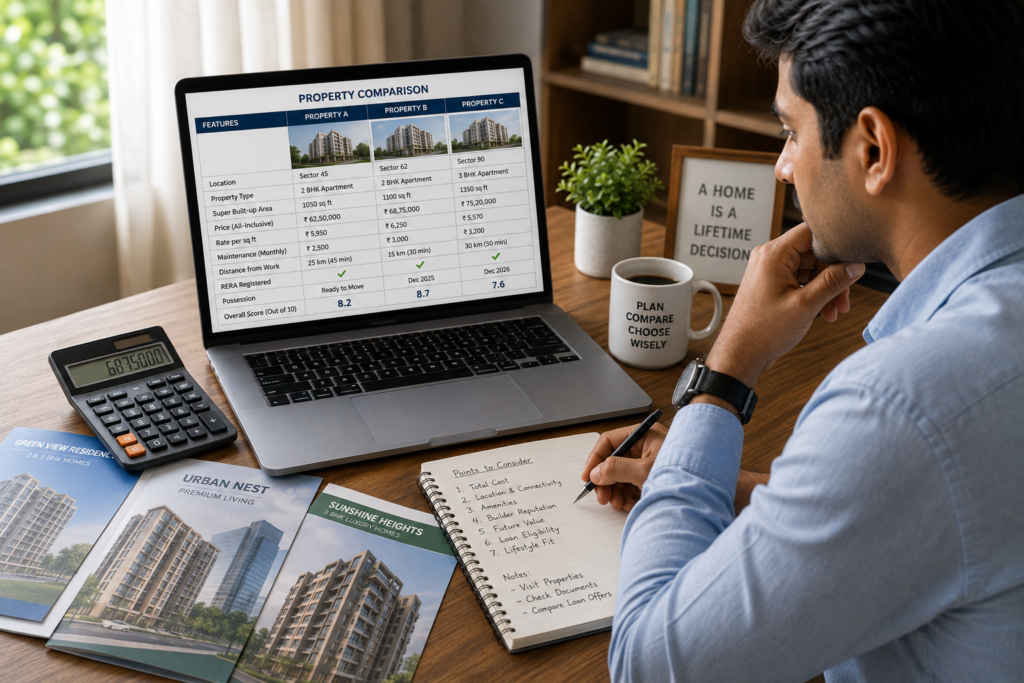
10. Compare the Property With Other Options
Do not compare only two properties.
If possible, shortlist several properties with similar:
- Budget
- Location
- Size
- Property type
- Age
- Amenities
- Connectivity
Then create a simple comparison table.
| Factor | Property A | Property B | Property C |
|---|---|---|---|
| Total Cost | ₹ | ₹ | ₹ |
| Location | Good | Very Good | Good |
| Travel Time | 40 min | 30 min | 45 min |
| Size | Medium | Large | Medium |
| Maintenance | ₹ | ₹ | ₹ |
| Property Age | New | 5 years | New |
| RERA Status | Check | Check | Check |
| Water Supply | Check | Check | Check |
| Parking | Yes/No | Yes/No | Yes/No |
| Overall Fit | High/Medium/Low | High/Medium/Low | High/Medium/Low |
This makes the decision more objective.
11. Think About Future Expenses
Buying a property does not end with registration.
After moving in, you may have:
- Maintenance charges
- Electricity bills
- Water charges
- Property taxes, where applicable
- Repairs
- Insurance
- Interior expenses
- Furniture expenses
- Appliance expenses
- Parking or facility-related costs
A bigger home may also mean higher maintenance and furnishing costs.
Therefore, ask yourself:
“Can I comfortably maintain this property for the next five to ten years?”
This question is often more useful than asking only whether you can buy it today.
12. Consider Tax Benefits Carefully
Home loans can have tax implications, but the benefit depends on factors such as the applicable tax regime, property type and the specific rules in force.
For example, the Income Tax Department’s current guidance describes certain deductions for eligible housing-loan interest and principal payments, including Section 24(b) and Section 80C under specified conditions.
However, buyers should not choose a property only because someone says it will provide a tax benefit.
Tax rules can change, and eligibility depends on individual circumstances.
For a large financial decision, verify the current rules with the Income Tax Department or a qualified tax professional.
13. Do Not Let Sales Pressure Control Your Decision
Real-estate sales often use phrases such as:
- “Only two units left.”
- “Offer ends today.”
- “Price will increase tomorrow.”
- “Book now to get a discount.”
- “This is the best investment.”
- “Everyone is buying here.”
Such statements should not replace proper research.
A home purchase is a long-term financial commitment.
Take time to:
- Verify the price.
- Compare alternatives.
- Check documents.
- Understand the agreement.
- Calculate the total cost.
- Review your loan.
- Think about your future needs.
A genuine good property should still make sense after careful checking.
14. Think About Resale and Rental Demand
Even if you are buying a home for your own use, it is sensible to consider its future marketability.
Factors that can influence demand may include:
- Location
- Connectivity
- Employment opportunities nearby
- Schools
- Healthcare
- Public transport
- Building quality
- Property maintenance
- Parking
- Layout
- Local development
But remember:
Past property-price growth does not guarantee future returns.
Avoid buying a property solely because someone promises that its price will double.
15. Buy for Your Lifestyle, Not Just for Investment
A home is different from a stock or other financial investment because you may have to live in it every day.
Suppose one property is slightly cheaper but requires a very long daily commute.
Another property may cost more but significantly reduce travel time.
The cheaper property is not necessarily the better choice.
Consider the value of:
- Time
- Convenience
- Safety
- Family needs
- Accessibility
- Quality of life
- Future requirements
Your home should support your life rather than create constant financial or practical stress.
16. Use a Simple Property Scorecard
You can give each shortlisted property a score from 1 to 5.
For example:
| Factor | Weight | Property A | Property B | Property C |
|---|---|---|---|---|
| Budget Fit | 25% | |||
| Location | 20% | |||
| Construction Quality | 15% | |||
| Connectivity | 10% | |||
| Legal/Regulatory Checks | 15% | |||
| Maintenance Cost | 5% | |||
| Future Suitability | 10% |
This does not make the decision automatically, but it can help you identify which property best matches your priorities.
17. Common Mistakes Home Buyers Should Avoid
Mistake 1: Buying the maximum amount the bank offers
Loan eligibility is not the same as comfortable affordability.
Mistake 2: Ignoring additional costs
The advertised price may not represent the complete purchase cost.
Mistake 3: Choosing a property only because it looks beautiful
A beautiful apartment cannot compensate for poor location, weak documentation or unaffordable payments.
Mistake 4: Skipping document verification
Property documents deserve serious attention.
Mistake 5: Ignoring maintenance costs
A large property with extensive facilities may have higher recurring costs.
Mistake 6: Not visiting the location
Photos and online listings cannot show everything.
Mistake 7: Trusting only verbal promises
Important commitments should be properly documented.
Mistake 8: Rushing because of a sales offer
Do your checks before paying.
Mistake 9: Forgetting future needs
A property that works today may not work for your family several years from now.
Mistake 10: Using all your savings
Keep an appropriate financial cushion for unexpected expenses.
18. A Practical Home-Buying Checklist
Before making the final decision, ask yourself:
- Is the property within my total budget?
- Have I calculated all additional costs?
- Can I comfortably manage the monthly loan payment?
- Do I have money left for emergencies?
- Have I compared similar properties?
- Is the location suitable for my daily life?
- Have I visited the property personally?
- Have I checked the project’s RERA information where applicable?
- Have the important property documents been verified?
- Have I understood the sale agreement?
- Have I checked maintenance and recurring costs?
- Have I checked the possession or completion information?
- Have I compared home-loan terms?
- Have I considered future family requirements?
- Am I making the decision without unnecessary sales pressure?
If several answers are “no,” consider doing more research before proceeding.
Final Thoughts
Finding the best residential property within your budget is not about finding the cheapest home or the most luxurious home.
It is about finding the right balance between price, location, quality, legal safety, monthly affordability and long-term suitability.
Start with your finances. Then identify your requirements. Research locations. Compare properties. Verify regulatory information and documents. Inspect the actual property. Understand the complete cost. Finally, make a decision based on facts rather than emotions or sales pressure.
For Indian home buyers, RERA is an important part of the property-checking process where applicable. The Ministry of Housing and Urban Affairs provides information about the RERA framework and links to State and UT regulatory authorities.
Home-loan terms also deserve careful attention. The Reserve Bank of India advises borrowers to understand whether a loan is fixed or floating, how the rate can change, applicable charges, the reset mechanism and other important terms.
The most important rule is simple:
Buy a home that fits your life and your finances—not just your dreams.
A carefully researched property can provide comfort and stability for years. A rushed purchase can create financial pressure for years.
Take your time, ask questions, verify important information and seek independent professional advice when needed. A little extra research before buying can make a very large difference after you become a homeowner.
Sources and Official References
- Ministry of Housing and Urban Affairs – RERA information and State/UT RERA authorities
- Real Estate (Regulation and Development) Act, 2016 – Government of India
- Reserve Bank of India – Home Loan FAQs
- Reserve Bank of India – Floating-rate loan guidance
- Income Tax Department – Housing-loan tax deduction information
Editorial note: This article is written in simple English and is structured to demonstrate useful E-E-A-T signals through practical guidance, first-hand-style decision steps, official government references and clear limitations. No article can itself be guaranteed to be “E-E-A-T approved” by Google; E-E-A-T is a quality framework rather than an approval certificate.