
Buying your first property is a major financial decision. For many people, it is not just about purchasing a house or apartment; it is about using years of savings to create a secure place to live and, in some cases, build long-term wealth.
The excitement of buying a home can sometimes make first-time buyers rush their decisions. A beautiful apartment, a discount offered by a salesperson, a promising location, or an attractive advertisement can create pressure to book quickly. However, property buying requires careful research because a mistake made at the beginning can become expensive and difficult to correct later.
In India, buyers also need to consider matters such as RERA registration, title and ownership documents, approvals, taxes, registration costs, loan conditions, possession timelines and the actual condition of the property. The Ministry of Housing and Urban Affairs advises buyers to check project information on the relevant RERA website rather than relying only on advertisements. It also advises buyers to understand payment terms, read the Agreement for Sale carefully and verify completion and occupancy certificates before taking possession.
This guide explains the top mistakes first-time property buyers should avoid. The language is simple, but the advice is practical and detailed so that you can use it while comparing properties.
Important: Property laws, stamp duty, registration charges, taxes, loan rules and local approvals can vary by state and property type. This article is general educational information, not legal, tax or financial advice. Before making a large payment, have the relevant documents checked by a qualified property lawyer and confirm applicable rules with the appropriate government authority.
Quick Summary
Before we discuss each mistake in detail, remember these basic rules:
- Do not decide your budget only from the property’s sale price.
- Do not buy a property only because the location looks attractive.
- Do not rely only on the builder, broker or salesperson for information.
- Verify ownership and important property documents independently.
- Check RERA registration where applicable.
- Inspect the property physically before buying.
- Research the builder’s previous projects and track record.
- Calculate maintenance and other recurring expenses.
- Understand your home loan before signing anything.
- Read the Agreement for Sale carefully.
- Compare the property’s total value, not just its advertised price.
- Never allow excitement or sales pressure to make the decision for you.
A good property purchase is usually the result of research, comparison and proper verification—not a rushed decision.
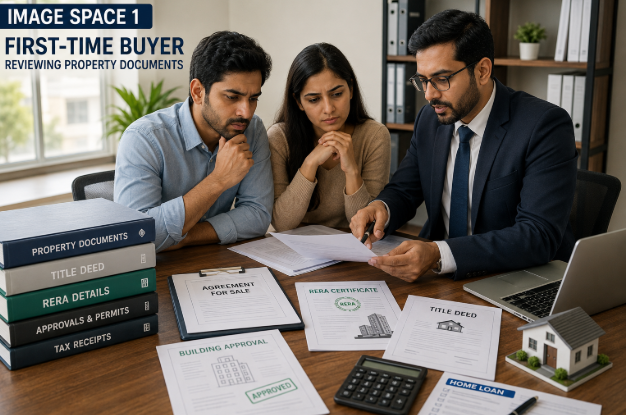
Why First-Time Buyers Need to Be Extra Careful
Buying a property is different from buying everyday products. If you purchase the wrong phone, car accessory or appliance, you may be able to replace it. A property is much more difficult to change or sell quickly without financial consequences.
A home can also affect your monthly budget for many years. If you take a housing loan, the EMI may continue for a long period. At the same time, you may have to pay maintenance charges, property taxes, insurance, repairs, utility bills and other expenses.
The legal side is equally important.
For example, India’s Real Estate (Regulation and Development) Act, 2016, commonly known as RERA, was created to improve transparency and protect homebuyers. The Ministry of Housing and Urban Affairs states that applicable real estate projects must be registered with the relevant State or Union Territory RERA authority before being advertised, marketed, booked or offered for sale.
That does not mean a buyer should stop doing their own checks. RERA is one part of due diligence. Your decision should also consider ownership, approvals, finances, construction quality, location and the terms of your agreement.
1. Mistake: Setting a Budget Based Only on the Property Price
One of the most common mistakes is thinking:
“If I can afford the property price, I can afford the property.”
This is not always true.
The advertised property price may not represent your complete cost. Depending on the transaction and location, you may also need to account for expenses such as:
- Stamp duty
- Registration charges
- Brokerage, if applicable
- Legal fees
- Loan processing and related charges
- Maintenance deposits
- Parking charges, where applicable
- Interior work
- Renovation
- Furniture and appliances
- Moving expenses
- Insurance
- Property taxes and other recurring costs
For an under-construction property, the payment schedule is also important. You should understand when payments are due and what happens if there are delays.
Pointer
Create a “total property cost” sheet before booking.
Do not write only the property price. Add every known one-time and recurring expense. Then check whether the purchase still fits comfortably within your finances.
Your emergency savings should also be considered. Avoid putting every rupee of your savings into the property and leaving yourself without a financial cushion.
2. Mistake: Taking the Maximum Home Loan You Are Offered
A bank approving a particular loan amount does not automatically mean you should borrow the maximum amount.
Your lender looks at your financial eligibility, but you also need to consider your personal comfort.
Ask yourself:
- Can I comfortably pay the EMI every month?
- What happens if my income falls temporarily?
- Do I have an emergency fund?
- Will I have other major expenses soon?
- Can I still save for retirement and other goals?
- Will the EMI remain manageable if household expenses increase?
Do not compare home loans only by looking at the interest rate. Look at the complete loan structure, including tenure, processing charges, reset conditions where applicable, prepayment terms and other costs.
Tax treatment can also change depending on the applicable tax regime and current law. For example, the Income Tax Department provides specific information about deductions relating to housing-loan interest and principal, but eligibility depends on the applicable rules and your circumstances.
Pointer
Calculate your EMI before you fall in love with the property.
It is better to buy a slightly less expensive home that you can comfortably afford than a dream home that creates financial stress for years.
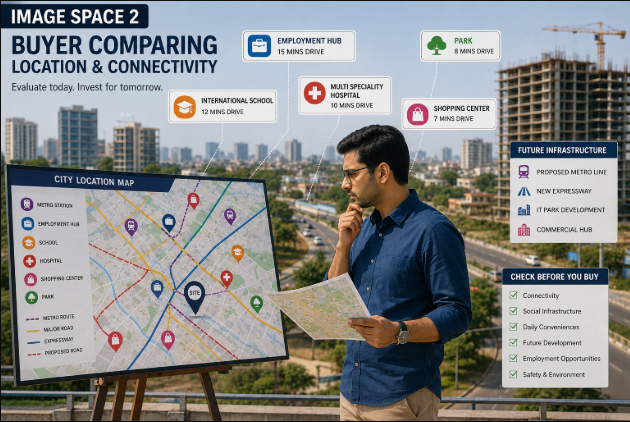
3. Mistake: Choosing a Property Only Because the Location Looks Good
A property may look excellent during a weekend visit but feel very different after you live there.
First-time buyers should investigate the location at different times of the day.
Check:
- Traffic during office hours
- Road conditions
- Public transport
- Distance from your workplace
- Schools
- Hospitals
- Grocery stores
- Banks and ATMs
- Parks and open spaces
- Water supply
- Electricity reliability
- Drainage
- Noise levels
- Safety and street lighting
- Future infrastructure
- Parking conditions
A location should work for your actual lifestyle, not just look good in a brochure.
Pointer
Visit the area at least three times:
Morning + evening + weekend
This can reveal traffic, noise, parking and neighbourhood issues that you may not notice during a sales visit.
4. Mistake: Believing Every Promise Made in an Advertisement
Property advertisements are designed to attract attention.
You may see phrases such as:
- “Five minutes from the airport”
- “Upcoming metro nearby”
- “Guaranteed high returns”
- “Best investment opportunity”
- “Limited units available”
- “Future commercial hub”
- “Premium lifestyle”
- “Guaranteed appreciation”
Do not make a purchase based only on these claims.
Ask for evidence.
If an infrastructure project is described as “upcoming,” find out whether it is officially approved, under construction or merely proposed.
Similarly, if someone promises a particular rental income or future property value, treat that as an estimate rather than a guarantee.
Pointer
Separate facts from sales claims.
Ask:
“Can you show me the official document or government source supporting this statement?”
That simple question can prevent poor decisions.
5. Mistake: Not Checking RERA Registration
For applicable projects covered by RERA, checking the relevant State or UT RERA portal is an important part of due diligence.
The Ministry of Housing and Urban Affairs advises buyers to check the RERA registration number and project information and not rely solely on advertisements.
RERA information can help a buyer investigate project details, including information submitted by the promoter.
However, checking RERA is not the same as completing all legal due diligence.
You should still investigate title, approvals, agreement terms, construction status and other relevant documents.
Pointer
Before paying a booking amount for an applicable project:
- Find the project’s RERA registration number.
- Visit the official RERA website for the relevant state or UT.
- Search for the project.
- Compare the information with what the salesperson has told you.
- Check the declared completion or possession information.
- Review available project and promoter details.
- Save copies or screenshots of important information for your records.
India’s RERA framework also requires applicable promoters to register projects before advertising or offering them for sale.
6. Mistake: Ignoring Property Title and Ownership Documents
This is one of the most serious mistakes.
You should know:
Who legally owns the property?
A property may have a complicated ownership history. There could also be issues involving inheritance, previous transfers, mortgages, disputes, encumbrances or other claims.
Do not assume that a document shown by a seller automatically proves that everything is clear.
A qualified property lawyer can examine the title chain and relevant records and advise you about potential issues.
Depending on the property and state, documents that may require examination can include:
- Sale deed
- Previous title documents
- Mother deed or parent documents, where relevant
- Encumbrance-related records
- Mutation records
- Property tax records
- Approved building plans
- Development or collaboration agreements, where applicable
- Power of attorney, where applicable
- Conversion or land-use documents, where applicable
- Completion or occupancy documents for completed projects
- Other local authority records
Pointer
Never treat legal verification as an unnecessary expense.
A professional legal review before purchase can be far less expensive than discovering a serious title problem after you have paid a large amount.
7. Mistake: Skipping Physical Property Inspection
Pictures and sample apartments can look perfect.
The actual property may tell a different story.
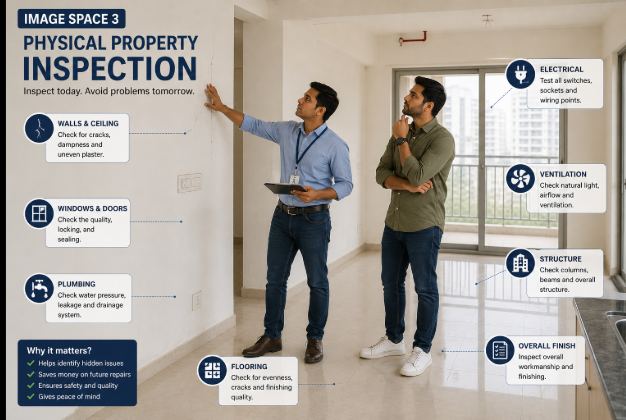
Before purchasing, inspect the property carefully.
Look for:
- Cracks
- Dampness
- Water leakage
- Poor ventilation
- Drainage problems
- Low-quality fittings
- Uneven flooring
- Poor doors and windows
- Electrical issues
- Plumbing problems
- Natural light
- Noise
- Mobile network coverage
- Parking access
- Lift condition
- Common-area maintenance
For an under-construction property, you may not be able to inspect the finished apartment. In that case, examine the construction site where permitted and understand the specifications promised in the agreement and project documents.
Pointer
Do not inspect only the sample flat.
If possible, visit an existing project by the same developer to see the actual construction and maintenance quality.
8. Mistake: Ignoring the Builder’s Track Record
A new project can look attractive because of its modern design, amenities and launch price.
But the developer’s history matters.
Research:
- Previous projects
- Construction quality
- Delivery history
- Delays
- Maintenance standards
- Customer complaints
- Litigation or regulatory issues that are publicly available
- Quality of completed buildings
- How promised amenities were delivered
- Reputation among existing residents
Do not depend entirely on online reviews. Talk to people living in completed projects if possible.
Pointer
Visit at least one completed project by the developer.
Ask residents simple questions:
- Was the project delivered on time?
- Were there major construction problems?
- How is maintenance?
- Are there water or power issues?
- Did the final product match the original promises?
Real residents can often provide practical information that brochures cannot.
9. Mistake: Ignoring Hidden and Recurring Costs
The purchase price is only one part of property ownership.
After buying, you may have regular expenses such as:
- Maintenance
- Society or association charges
- Repairs
- Property tax
- Insurance
- Parking-related expenses
- Utilities
- Security
- Lift maintenance
- Clubhouse or amenity charges, where applicable
These expenses can become significant over time.
Pointer
Ask the seller, builder or association for a realistic estimate of recurring costs.
Do not ask only:
“How much is the maintenance?”
Also ask:
“What exactly is included in the maintenance amount, and can the charges change in the future?”
10. Mistake: Not Reading the Agreement for Sale Carefully
Many buyers read only the first few pages of an agreement or rely on the salesperson to explain it.
That is risky.
The agreement may contain important information about:
- Property description
- Carpet area
- Payment schedule
- Possession date
- Cancellation terms
- Delay-related provisions
- Maintenance
- Parking
- Amenities
- Specifications
- Charges
- Buyer obligations
- Developer obligations
- Default provisions
The Ministry of Housing and Urban Affairs specifically advises buyers to read the Agreement for Sale carefully and understand their rights and responsibilities.
Pointer
Do not sign an agreement simply because someone tells you:
“This is the standard agreement. Everyone signs it.”
Read it yourself and, for a significant purchase, have an independent property lawyer review it.
11. Mistake: Paying a Large Amount Before Understanding the Agreement
A buyer may feel pressured to pay quickly because of a supposed “last unit” or “today-only” offer.
Do not let urgency replace due diligence.
The Ministry’s RERA guidance states that buyers should not pay more than 10% of the amount without first having an Agreement for Sale executed, subject to the applicable RERA provisions and rules.
The exact legal position can depend on the transaction and applicable state rules, so confirm it for your property.
Pointer
Before making a substantial payment, understand:
What am I paying? Why am I paying it? What document supports this payment? What happens if the transaction does not proceed?
Keep receipts and transaction records.
The Ministry also advises buyers to obtain receipts and avoid cash payments in order to maintain a proper record.
12. Mistake: Focusing Only on the Cheapest Property
A low price does not automatically mean a good deal.
A cheap property may have:
- Poor connectivity
- Weak construction
- Legal problems
- Limited resale demand
- High maintenance costs
- Poor water supply
- Limited parking
- Weak rental demand
- Unclear approvals
- Poor surrounding infrastructure
Instead of asking:
“Which property is cheapest?”
ask:
“Which property gives me the best overall value for my budget?”
Pointer
Compare properties using several factors:
| Factor | Property A | Property B | Property C |
|---|---|---|---|
| Total cost | |||
| Location | |||
| Connectivity | |||
| Legal status | |||
| RERA status | |||
| Construction quality | |||
| Builder reputation | |||
| Maintenance cost | |||
| Loan affordability | |||
| Resale potential |
This makes your decision more objective.
13. Mistake: Forgetting About Resale and Rental Demand
Even if you are buying a home for yourself, it is useful to think about future flexibility.
Life can change.
You may change jobs, move to another city, expand your family or need to sell the property for financial reasons.
A property with good connectivity, practical amenities, employment access and strong local demand may be easier to rent or sell than a property in an isolated location.
This does not mean you should buy only for investment returns. Your own needs should remain important.
Pointer
Think about both:
“Would I enjoy living here?”
and
“Would other buyers or tenants find this location useful?”
14. Mistake: Not Checking the Surrounding Area
Do not inspect only the apartment.
Walk around the neighbourhood.
Check what is located nearby and what may be built in the future.
Look for:
- Factories
- High-traffic roads
- Open drains
- Waste facilities
- Flood-prone areas
- High-voltage infrastructure
- Construction sites
- Commercial activity
- Schools
- Hospitals
- Public transport
- Markets
- Parks
Also ask local residents about issues such as waterlogging, noise and power supply.
Pointer
Spend at least a few hours in the neighbourhood before making a final decision.
A property’s surroundings can affect your daily life just as much as the property itself.
15. Mistake: Not Comparing Multiple Properties
First-time buyers sometimes fall in love with the first property they visit.
That can make comparison difficult.
Try to shortlist at least three realistic options before making the final decision.
For each property, record:
- Price
- Carpet area
- Location
- Travel time
- Amenities
- Maintenance
- Builder
- RERA information
- Legal status
- Possession
- Loan options
- Total purchase cost
Pointer
Do not compare properties from memory.
Write the information down.
A simple comparison table can make differences much easier to see.
16. Mistake: Ignoring the Difference Between Carpet Area and Other Measurements
Property advertisements can use different measurements.
First-time buyers should understand what area they are actually paying for.
Do not compare two properties simply because both advertisements say “1,200 sq. ft.”
Ask what that number represents.
For a residential apartment, understand the carpet area and what is included or excluded in other area calculations.
RERA’s framework has also emphasized disclosure of carpet area as part of improving transparency for buyers.
Pointer
Ask the seller to provide the area details in writing.
Then compare properties on a like-for-like basis.
17. Mistake: Ignoring Possession and Completion Documents
If you are buying a completed property, do not assume that “ready to move” automatically means everything is legally complete.
Depending on the property and local rules, relevant completion and occupancy documentation may be important.
The Ministry of Housing and Urban Affairs advises buyers to take possession only after checking applicable occupancy and completion certificates.
Pointer
Before taking possession, ask:
- What certificates have been issued?
- Which authority issued them?
- Does the document apply to the property/project?
- Are all promised facilities ready?
- Are there outstanding issues?
For legal interpretation, use a qualified professional.
18. Mistake: Forgetting About Taxes and Registration Requirements
Property transactions can involve tax and registration obligations.
For example, the Income Tax Department provides specific guidance for TDS relating to transfers of immovable property above the applicable threshold. Its current guidance states that TDS is required where the property value or applicable stamp duty value exceeds ₹50 lakh, subject to the conditions of the law.
Tax rules can change, so buyers should verify the current requirements before completing a transaction.
Stamp duty and registration costs can also vary between states and may depend on the property and transaction.
Pointer
Do not wait until the final day to discover that you need to arrange additional money for taxes, stamp duty or registration.
Ask your lawyer, tax professional or relevant government authority for the current applicable charges.
19. Mistake: Trusting Verbal Promises
A salesperson may verbally promise:
- Free parking
- A particular view
- Certain fittings
- A clubhouse facility
- A discount
- A possession date
- Waiver of a charge
- Additional work
Verbal promises can become difficult to prove later.
Pointer
If it matters, put it in writing.
Make sure important promises are reflected in the appropriate official document or agreement.
Keep copies of:
- Brochures
- Payment receipts
- Emails
- Written commitments
- Agreements
- All relevant correspondence
20. Mistake: Rushing Because of Sales Pressure
“Book today.”
“Only one unit remains.”
“The price increases tomorrow.”
“Someone else is ready to buy.”
These statements may create urgency.
Sometimes there really are limited units or changing prices, but that does not mean you should skip essential checks.
A property purchase is too important to make based purely on pressure.
Pointer
Create your own rule:
No major payment until budget, documents, legal checks and property details have been reviewed.
A genuine opportunity should survive reasonable due diligence.
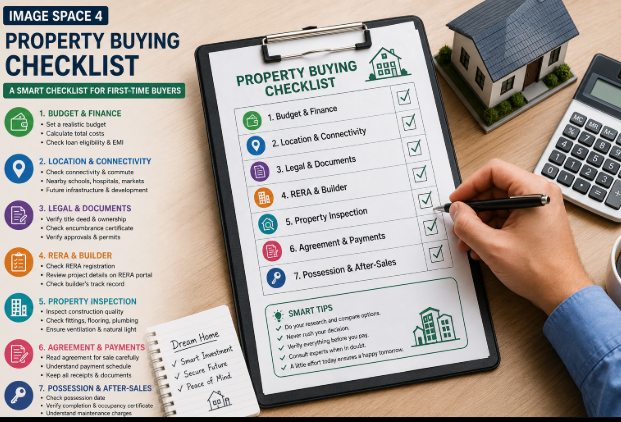
A Simple First-Time Property Buying Checklist
Before you make the final decision, use this checklist:
- Set a realistic total budget.
- Keep an emergency fund.
- Calculate the affordable EMI.
- Compare loan options.
- Research the location.
- Visit the neighbourhood at different times.
- Compare several properties.
- Verify RERA registration where applicable.
- Check project information on the official RERA portal.
- Verify ownership and title documents.
- Check relevant approvals.
- Review property tax and other applicable records.
- Physically inspect the property.
- Research the builder’s previous projects.
- Understand carpet area and other area measurements.
- Calculate maintenance and recurring costs.
- Read the Agreement for Sale carefully.
- Have important documents reviewed by a qualified lawyer.
- Understand taxes and registration costs.
- Keep records of all payments.
- Avoid undocumented cash transactions.
- Verify possession and applicable completion/occupancy documents.
- Do not make a rushed decision because of sales pressure.
Smart Questions to Ask Before Buying
Take these questions with you when meeting a builder, seller or broker.
About the property
- What is the exact carpet area?
- What is included in the quoted price?
- What additional charges will I have to pay?
- What is the possession status?
- Are there any pending approvals?
About legal matters
- Who is the legal owner?
- Can I review the title documents?
- Are there any known disputes or encumbrances?
- Which approvals have been obtained?
- Has an independent lawyer reviewed the documents?
About RERA
- What is the RERA registration number?
- Does the RERA portal information match the sales material?
- What possession/completion date is recorded?
- What project details are publicly available?
About finance
- What will my total purchase cost be?
- What is my expected EMI?
- What are the loan-related charges?
- What happens if interest rates change?
- What other expenses should I budget for?
About the neighbourhood
- How far is public transport?
- How long does commuting take during peak hours?
- What schools and hospitals are nearby?
- Is there a reliable water supply?
- Are there known drainage or flooding issues?
Good questions can reveal problems before you commit your money.
How to Make a Safer Property-Buying Decision
A simple process can make property buying much easier.
Step 1: Decide your real budget
Start with your income, savings, existing loans and future expenses.
Do not start with the most expensive property you can technically qualify for.
Step 2: Decide what you need
Write down your must-have requirements.
For example:
- Location
- Number of bedrooms
- Maximum travel time
- Parking
- School access
- Hospital access
- Public transport
- Budget
Separate must-have features from nice-to-have features.
Step 3: Shortlist properties
Compare at least three realistic options.
Step 4: Research the location
Visit the area and talk to local residents.
Step 5: Verify documents
Do not rely solely on the seller’s explanation.
Use an independent legal professional where appropriate.
Step 6: Verify RERA information
For applicable projects, check the relevant State or UT RERA portal. The Ministry of Housing and Urban Affairs provides a list of State and UT RERA authorities.
Step 7: Inspect the property
Look beyond appearance.
Step 8: Review the finances
Calculate the total cost, EMI and ongoing expenses.
Step 9: Read the agreement
Understand what you are signing before signing it.
Step 10: Make the payment carefully
Use traceable payment methods and maintain proper records.
Step 11: Complete registration and possession checks
Follow the applicable legal and local procedures.
What First-Time Buyers Should Remember About RERA
RERA has made the Indian real estate market more transparent, but buyers should understand its role correctly.
The Ministry of Housing and Urban Affairs explains that RERA aims to improve transparency, accountability and protection of homebuyers. It also requires applicable projects to be registered with the relevant State or UT regulator.
The Ministry’s buyer guidance recommends several practical precautions, including:
- Checking RERA registration.
- Checking project information on the RERA website.
- Understanding payment terms.
- Reading the Agreement for Sale.
- Checking the declared possession/completion information.
- Keeping payment receipts.
- Avoiding cash payments.
- Checking applicable occupancy and completion certificates before possession.
- Approaching RERA promptly if there is a relevant non-compliance or grievance.
However, RERA should be treated as one part of your overall due-diligence process, not a replacement for independent legal, financial and physical checks.
E-E-A-T: Why Independent Verification Matters
When writing or researching about property, trustworthy information is especially important because readers may make decisions involving large amounts of money.
A responsible first-time buyer should prefer:
Experience
Learn from people who have actually purchased or lived in similar properties. Existing residents can provide useful practical information about maintenance, water, construction and neighbourhood conditions.
Expertise
For complicated matters, use qualified professionals such as property lawyers, chartered accountants, architects, engineers or other appropriately qualified specialists.
Authoritativeness
Prefer information from official government and regulatory sources when checking laws, regulations, tax rules and RERA requirements. For example, the Ministry of Housing and Urban Affairs publishes information about RERA and State/UT regulatory authorities.
Trustworthiness
Do not accept important claims simply because they appear in an advertisement or are repeated by a salesperson.
Verify important information independently.
This approach is particularly important because property laws and financial rules can change.
Final Thoughts
Buying your first property should be exciting, but it should not be rushed.
The biggest mistake is not choosing the “wrong” colour, floor or apartment layout. The bigger risks are financial over-stretching, incomplete document checks, unclear ownership, poor location research, hidden costs, weak legal verification and signing agreements without understanding them.
A smart first-time buyer takes a step back before taking a step forward.
Check the money.
Check the location.
Check the documents.
Check RERA where applicable.
Check the property.
Check the agreement.
Then make the decision.
Remember that the cheapest property is not always the best property, and the most expensive property is not necessarily the best investment. The right property is one that fits your budget, meets your needs, has acceptable legal and physical due diligence, and makes financial sense for your situation.
Take your time. Ask questions. Keep written records. Get professional help when the matter is beyond your knowledge.
A few extra days spent on research can potentially save you from years of financial and legal stress.
Final First-Time Buyer Pointers
Before booking:
- Budget first, property second.
- Never ignore additional costs.
- Do not borrow more than you can comfortably repay.
- Research the neighbourhood, not just the building.
- Verify RERA information where applicable.
- Get important property documents checked independently.
- Inspect the actual property whenever possible.
- Research the builder’s previous projects.
- Read every important clause in the Agreement for Sale.
- Keep proof of every payment.
- Do not rely on verbal promises.
- Check applicable completion and occupancy documents before possession.
- Do not allow sales pressure to replace due diligence.
- When in doubt, consult a qualified professional.
One-Line Takeaway
For a first-time property buyer, the safest approach is simple: never buy only with your heart—use your budget, research, documents, inspection and professional advice to make the final decision.
Official Sources Used for This Guide
- Ministry of Housing and Urban Affairs — Real Estate (Regulation and Development) Act, 2016 and RERA information.
- Ministry of Housing and Urban Affairs — RERA FAQs for buyers and project registration requirements.
- Ministry of Housing and Urban Affairs — RERA buyer Do’s and Don’ts.
- Income Tax Department — guidance relating to TDS on transfer of immovable property.
- Income Tax Department — current information on housing-property tax provisions.
Disclaimer: This article is for general educational purposes. Property transactions involve state-specific laws, regulations and financial/tax considerations. Always verify current requirements with the relevant government authority and obtain independent professional advice before making a property purchase.