
Affordable Properties in India: A Complete Guide to Finding Your Dream Home on a Budget
Target Audience: First-time homebuyers, families, budget-conscious buyers, and property investors
Topic: Affordable Properties
Language: Simple English
Article Type: Informative Real Estate Guide
SEO Title
Affordable Properties: How to Find Your Dream Home on a Budget
Meta Description
Looking for affordable properties in India? Learn how to find budget-friendly homes, check documents, compare prices, arrange finance, and buy safely.
Suggested URL Slug
/affordable-properties-india/
Affordable Properties: How to Find Your Dream Home on a Budget
Buying a home is one of the biggest financial decisions in a person’s life. For many people, the dream of owning a house can feel difficult because property prices, home loans, registration charges, and other costs can be expensive. However, finding affordable properties is possible with proper planning, research, and financial discipline.
An affordable property does not simply mean the cheapest house available. A truly affordable home should fit your budget, meet your family’s needs, be located in a suitable area, and have clear legal documents. You should also be able to manage the monthly loan EMI and other expenses without putting too much pressure on your finances.
In India, affordable housing continues to receive attention from both government schemes and the real estate sector. PMAY-U 2.0 includes multiple support options for eligible urban households, including affordable housing, rental housing, beneficiary-led construction, and interest subsidy support. Eligibility and benefits depend on the scheme category and individual circumstances.
This complete guide will help you understand what affordable properties are, where to find them, how to compare options, what documents to check, and how to make a safe buying decision.
Table of Contents
- What Are Affordable Properties?
- Why Affordable Properties Are Popular
- How Much Home Can You Afford?
- Different Types of Affordable Properties
- How to Choose the Right Location
- Check the Total Cost, Not Just the Property Price
- Government Housing Support and Eligibility
- How to Find Affordable Properties
- Important Documents to Check
- Why RERA Verification Matters
- Home Loans for Affordable Properties
- New Property vs Resale Property
- Common Mistakes to Avoid
- Tips for First-Time Buyers
- Affordable Property as an Investment
- How Chotala Homes Can Help
- Summary and Key Pointers
- Frequently Asked Questions
- Final Thoughts
1. What Are Affordable Properties?
Affordable properties are homes, flats, apartments, plots, or houses that are reasonably priced for a particular buyer or family.
However, affordability is different for every person.
For one family, a ₹30 lakh home may be affordable. For another family, a ₹70 lakh property may fit comfortably within their income and savings. Therefore, you should not decide affordability only by looking at the property’s selling price.
A property is generally affordable for you when:
- You can pay the down payment without financial stress.
- The home loan EMI fits comfortably within your monthly budget.
- You can manage registration and other buying costs.
- You still have money for daily expenses and savings.
- The location suits your work and family needs.
- The property has proper legal documents.
A low-price property is not always a good deal. For example, a cheap house located very far from schools, hospitals, transport, and workplaces may create high daily travel expenses.
Therefore, true affordability means balancing price, location, quality, legal safety, and long-term living costs.

2. Why Affordable Properties Are Popular
Affordable properties are popular because they make homeownership more achievable for first-time buyers and middle-income families.
Many buyers do not need a luxury villa or a large premium apartment. Their main requirements may be:
- A safe home.
- Enough space for the family.
- Good water and electricity facilities.
- Nearby schools and hospitals.
- Easy access to work or public transport.
- A reasonable price.
- A manageable home loan EMI.
Affordable housing options can help buyers enter the property market without taking unnecessary financial risks.
Government programmes also support eligible buyers and households through different housing initiatives. Under PMAY-U 2.0, the Ministry of Housing and Urban Affairs provides different components for eligible urban households, while the exact benefit depends on factors such as income category, eligibility, location, and the applicable scheme rules.
3. How Much Home Can You Afford?
Before searching for properties, calculate your budget.
This is one of the most important steps.
Do not start by looking at expensive homes and then trying to arrange the money later. First, understand your financial position.
Consider Your Monthly Income
Calculate your total household income.
For example:
- Your salary or business income.
- Your spouse’s income.
- Other regular income, if reliable.
Then calculate your regular expenses.
These may include:
- Food and groceries.
- Education expenses.
- Transportation.
- Existing loans.
- Insurance.
- Medical expenses.
- Savings and investments.
- Family responsibilities.
The money left after necessary expenses gives you a clearer idea of what EMI you may be able to manage.
Save for the Down Payment
Most buyers need to arrange part of the property’s cost themselves. You may also need money for additional buying expenses.
Try not to use every rupee of your savings for the down payment. Keep an emergency fund for unexpected situations.
Use a Comfortable EMI
Just because a bank is willing to approve a larger loan does not always mean you should take the maximum amount.
Choose an EMI that allows you to continue:
- Saving money.
- Managing emergencies.
- Paying family expenses.
- Maintaining insurance coverage.
- Living without constant financial stress.

4. Different Types of Affordable Properties
Affordable properties are available in different forms.
Affordable Flats
Flats are a popular option in cities and developing urban areas.
Benefits may include:
- Security.
- Shared amenities.
- Easier maintenance.
- Community living.
- Better access to city infrastructure.
A 1 BHK or 2 BHK flat may be suitable for a small family or first-time buyer.
Independent Houses
An independent house may provide more privacy and freedom. Depending on the location, it may also offer future expansion possibilities.
However, buyers should carefully check:
- Land ownership.
- Building approvals.
- Construction quality.
- Access roads.
- Water and electricity connections.
Resale Properties
A resale property can sometimes be more affordable than a newly launched property.
Possible advantages include:
- Negotiation opportunities.
- Ready-to-move availability.
- An established neighbourhood.
- Existing infrastructure.
However, document verification is extremely important.
Plots and Land
Buying a plot can sometimes be more affordable than purchasing a completed house. Buyers may construct the home later according to their budget.
Before buying land, carefully verify ownership, land use, approvals, access, and other legal requirements.
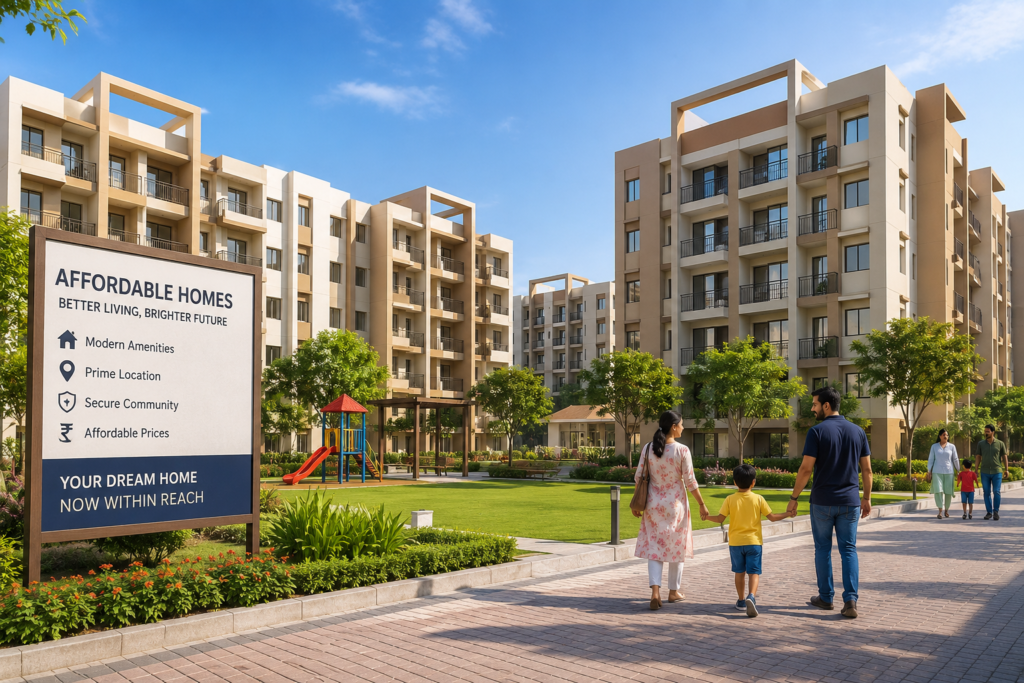
Affordable Housing Projects
Some projects are specifically developed for budget-conscious buyers. Under the Affordable Housing in Partnership framework, affordable housing projects may involve public or private agencies and have specific eligibility and regulatory requirements. The applicable rules and benefits should always be checked before booking.
5. How to Choose the Right Location
Location has a major effect on affordability.
A property outside the main city may have a lower purchase price. But before buying, calculate the total cost of living there.
Ask yourself:
- How far is my workplace?
- Are schools nearby?
- Is there a hospital nearby?
- Is public transport available?
- Are markets and daily services easily accessible?
- How much will I spend on travel every month?
- Is the area developing?
- Are roads and infrastructure improving?
A slightly more expensive property in a good location may sometimes be more affordable in the long term than a very cheap property in an inconvenient area.
Look for Emerging Areas
Developing areas can offer lower property prices compared with fully developed premium locations.
However, do proper research.
Check:
- Road connectivity.
- Metro or public transport plans.
- Schools and hospitals.
- Employment centres.
- Water and electricity availability.
- Legal development permissions.
Do not buy only because someone says, “Prices will double soon.” Property decisions should be based on verified information, not promises.
[IMAGE SPACE: Homebuyer studying a city map showing metro routes, highways, schools, hospitals and affordable residential areas]
6. Check the Total Cost, Not Just the Property Price
This is one of the biggest mistakes made by buyers.
Suppose you see an apartment advertised for ₹40 lakh. The final amount you spend may be higher because of additional costs.
Depending on the property and local rules, costs may include:
- Stamp duty.
- Registration charges.
- GST, where applicable.
- Parking charges.
- Maintenance deposits.
- Brokerage or service fees.
- Home loan processing charges.
- Legal verification costs.
- Interior and furnishing expenses.
- Moving costs.
Before booking any property, ask for a clear cost breakdown.
Your Checklist
Ask:
What is included in the advertised price?
Also ask:
- Is parking included?
- Are maintenance charges separate?
- Are there any club or amenity charges?
- Are utility connection charges extra?
- Are taxes included or extra?
- What will be the approximate monthly maintenance cost?
A clear financial calculation helps you avoid surprises.
7. Government Housing Support and Eligibility
Eligible homebuyers may have access to housing support under government programmes.
PMAY-U 2.0 is designed to support eligible urban households through four broad verticals, including Beneficiary Led Construction, Affordable Housing in Partnership, Affordable Rental Housing, and an Interest Subsidy Scheme. The programme details, income categories, and benefits can vary by component and eligibility.
For example, official PMAY-U 2.0 information describes an interest subsidy component for eligible EWS, LIG, and MIG households, with scheme-specific income limits and conditions. The official information states that the maximum subsidy under this component can be up to ₹1.80 lakh for eligible beneficiaries.
Important: Government scheme rules can change. Always verify current eligibility, documents, income limits, property conditions, and application procedures on the official government website before making a financial decision.

8. How to Find Affordable Properties
Finding the right affordable property requires patience.
Set Your Maximum Budget
Decide your maximum purchase budget before contacting sellers.
Do not increase your budget every time you see a better property.
Keep a realistic financial limit.
Compare Multiple Properties
Never buy the first property you see unless you have already compared the local market carefully.
Compare:
- Price.
- Area.
- Location.
- Property age.
- Amenities.
- Legal status.
- Construction quality.
- Connectivity.
Visit the Property
Photos can be attractive, but a physical visit is important.
Check:
- Natural light.
- Ventilation.
- Water supply.
- Road access.
- Parking.
- Building condition.
- Noise levels.
- Nearby surroundings.
Work With a Trusted Real Estate Professional
A knowledgeable property professional can help you:
- Understand local prices.
- Find options within your budget.
- Compare properties.
- Arrange site visits.
- Understand basic documentation.
- Negotiate more effectively.
However, buyers should still independently verify important legal and financial matters.
9. Important Documents to Check Before Buying
Document verification is essential, especially when buying an affordable property.
Important documents may include:
Title Documents
These help establish ownership of the property.
Sale Deed
The sale deed is an important document in a property transfer.
Previous Ownership Documents
For resale properties, previous ownership records may need to be reviewed.
Approved Building Plans
Check whether the building has been constructed according to applicable approvals.
Occupancy or Completion Documents
The required documents depend on the type of property and local regulations.
Property Tax Records
Check whether applicable property taxes have been paid.
Encumbrance Information
This can help identify certain registered financial or legal claims associated with a property.
Because property documentation can be complex, consider consulting a qualified property lawyer for independent legal verification.

10. Why RERA Verification Matters
RERA was created to improve transparency and accountability in the real estate sector and protect homebuyers.
Government information states that RERA requires applicable real estate projects to be registered with the regulatory authority before advertising, marketing, booking, or sale, subject to the provisions and exemptions of the law.
Before booking an under-construction property, check relevant RERA details where applicable.
Look at information such as:
- Project registration details.
- Promoter details.
- Project completion information.
- Approvals and disclosures available on the relevant RERA portal.
Do not depend only on verbal claims.
If someone says a project is RERA registered, verify the details independently.
A recent government-backed housing update also highlights the importance of checking project RERA registration and independently verifying developer claims.
11. Home Loans for Affordable Properties
A home loan can make property ownership possible, but you should understand the loan carefully.
Compare:
- Interest rates.
- Loan tenure.
- EMI amount.
- Processing fees.
- Prepayment conditions.
- Foreclosure charges, where applicable.
- Insurance requirements.
Do not choose a loan only because it has a low starting interest rate.
Read the complete terms and conditions.
Improve Your Loan Readiness
Before applying:
- Maintain a good credit history.
- Pay existing EMIs on time.
- Keep income documents organised.
- Avoid taking unnecessary new debt.
- Maintain stable financial records.
Always ask the lender for a complete explanation if you do not understand a charge.
12. New Property vs Resale Property
Both options can be affordable.
New Property
Advantages may include:
- Modern design.
- New construction.
- Developer amenities.
- Possible payment plans.
Risks may include:
- Construction delays.
- Additional charges.
- Differences between promises and final delivery.
Resale Property
Advantages may include:
- Ready possession.
- Possibility of price negotiation.
- Established neighbourhood.
- Existing infrastructure.
Risks may include:
- Repair requirements.
- Older construction.
- Previous legal or ownership issues.
There is no single best option. Compare the complete financial and legal situation before deciding.
13. Common Mistakes to Avoid
Buying Only Because the Price Is Low
A cheap property may have hidden problems.
Always ask why the price is lower than nearby properties.
Ignoring Location
Low property cost can be cancelled by high travel and daily expenses.
Not Checking Documents
Never skip legal verification to save money.
Paying Large Amounts Without Proper Documentation
Keep proper payment records and receipts.
Believing Verbal Promises
Important commitments should be properly documented.
Taking an Uncomfortable Loan
A large EMI can create financial stress for many years.
Not Checking the Property Personally
Visit the property and surrounding area.
14. Tips for First-Time Buyers
Here are simple tips for buying your first affordable property:
- Set a realistic budget.
- Keep emergency savings separate.
- Compare several properties.
- Visit each shortlisted property.
- Calculate all additional costs.
- Check documents carefully.
- Verify applicable RERA details.
- Compare home loan options.
- Do not make decisions under pressure.
- Take professional legal advice when necessary.
15. Affordable Property as an Investment
An affordable property can also be an investment, but buyers should not assume that every property will provide high returns.
When evaluating an investment property, consider:
- Rental demand.
- Location growth.
- Connectivity.
- Employment opportunities nearby.
- Future infrastructure.
- Property maintenance costs.
- Local supply of similar homes.
A property in a strong location may perform better over time than a larger property in a weak location.
For investors, the goal should be to understand both potential returns and risks.
16. How Chotala Homes Can Help You Find Affordable Properties
At Chotala Homes, our goal is to help buyers explore property options that match their requirements and budget.
When searching for affordable properties, a good property search should focus on more than just the lowest price.
Buyers can consider:
- Budget.
- Preferred location.
- Family size.
- Property type.
- Investment goals.
- Ready-to-move or under-construction preferences.
- Basic document and project information.
We encourage buyers to compare options carefully and make informed decisions.

Summary: What Makes a Property Truly Affordable?
A truly affordable property is not simply the cheapest property available.
It should offer a balance between:
- Reasonable purchase price
- Comfortable monthly EMI
- Suitable location
- Good basic facilities
- Clear and properly verified documentation
- Manageable maintenance costs
- Long-term usefulness for your family
Government housing programmes and financing support may also help eligible buyers, but you should always verify current eligibility and terms directly through official sources before relying on a benefit.
Quick Key Pointers
- Affordable means affordable for your personal budget.
- Do not judge a property only by its advertised price.
- Calculate registration, taxes, maintenance, and other costs.
- Choose a location based on daily convenience and future needs.
- Compare multiple properties before deciding.
- Inspect the property physically.
- Verify important documents carefully.
- Check applicable RERA information independently.
- Choose a home loan EMI you can manage comfortably.
- Keep emergency savings even after paying the down payment.
- Check government housing benefits only through official sources.
- Take independent legal or financial advice when needed.
Frequently Asked Questions About Affordable Properties
1. What is considered an affordable property?
An affordable property is a home that fits comfortably within a buyer’s income, savings, and borrowing capacity while meeting important family needs.
2. Is a cheaper property always a better deal?
No. A very cheap property may have problems related to location, construction, documents, maintenance, or connectivity.
3. Should I buy a new property or a resale property?
Both can be good choices. Compare the total cost, location, property condition, documents, and your personal needs.
4. Can first-time buyers get government housing benefits?
Eligible buyers may qualify for benefits under applicable government housing programmes. Eligibility depends on the current rules, income category, property details, and other conditions.
5. Why should I check RERA details?
RERA can provide important project and promoter information for applicable projects and supports transparency and accountability in the real estate sector.
6. How much should I save for a down payment?
The amount depends on the property’s cost, lender requirements, and your financial situation. You should also keep separate funds for additional buying expenses and emergencies.
7. What is the biggest mistake when buying an affordable property?
One of the biggest mistakes is focusing only on the property price and ignoring documents, location, additional costs, and long-term expenses.
Final Thoughts
Finding affordable properties requires smart planning, patience, and proper research.
Do not rush because a seller says, “This offer is available only today.” Take time to understand the complete cost, inspect the property, compare alternatives, and verify important information.
Your home should not become a constant financial burden.
The best affordable property is one that provides a safe and comfortable place to live while remaining financially manageable for your family. By setting a clear budget, checking the location, understanding the total cost, verifying documents, and reviewing financing options carefully, you can make a more confident property-buying decision.
Call to Action
Looking for affordable properties that match your budget? Explore suitable options with Chotala Homes and take the next step towards finding a home for your family.
Suggested Images for This Article
- Family outside an affordable apartment.
- Couple calculating home loan EMI and budget.
- Affordable housing apartment project.
- Buyer checking location and city map.
- Family reviewing affordable housing scheme information.
- Property lawyer checking legal documents.
- Buyer checking RERA information online.
- Real estate consultant showing affordable property options.
- Happy family receiving keys to their new home.
Suggested Meta Tags
Primary Keyword: Affordable Properties
Secondary Keywords: Affordable homes, budget-friendly properties, affordable flats in India, low-budget property, first-time home buyer, affordable housing India, budget homes
Suggested Blog Tags
Affordable Properties, Affordable Housing, Property Buying, Real Estate, Home Buyers, Budget Homes, Affordable Flats, First-Time Home Buyer, Property Investment, Chotala Homes
About the Author
Chotala Homes Editorial Team creates practical real estate content to help homebuyers understand property prices, locations, documents, financing, and important steps involved in buying a property. Our content is designed to support informed decision-making, but readers should independently verify legal, financial, and government-scheme information before making a final property decision.