
For: Investors
Real estate has long been considered one of the most important investment options in India. From residential apartments and independent houses to plots, commercial properties, and rental assets, property can offer both long-term wealth creation and regular income.
But is property still a good investment in 2026?
The short answer is: it can be, but the right property and the right location matter more than ever. Investors should not buy a property simply because prices are rising or because someone says a particular area will become the “next big location.” A successful real estate investment requires research, financial planning, legal checks, and an understanding of future demand.
India’s residential market entered 2026 with a relatively strong foundation. Knight Frank’s H2 2025 research described the residential market as resilient, with demand supported by economic growth and earlier interest-rate easing. At the same time, the market has become more selective, with stronger demand for higher-value homes and differences between affordable, mid-market, and premium segments.
This guide explains how investors can evaluate real estate in India in simple terms and, most importantly, how to choose the best location for real estate investment in 2026.
Quick Summary
Before buying property in 2026, remember these key points:
- Location is one of the biggest factors affecting property demand and resale value.
- Good roads, public transport, schools, hospitals, offices, and shopping facilities can support long-term demand.
- Do not invest only because an area is cheap. A low price can sometimes indicate weak demand or poor infrastructure.
- Look for locations where employment, infrastructure, population, and connectivity are improving.
- Check the property’s legal documents and applicable approvals before paying a large amount.
- Calculate the complete cost, including registration, taxes, maintenance, loan interest, brokerage, interiors, and other expenses.
- Decide whether your goal is capital appreciation, rental income, or both.
- Visit the location personally at different times of the day.
- Compare several properties instead of buying the first property you see.
- Avoid making decisions based only on promises of guaranteed returns.
- Real estate is generally a long-term investment, so investors should be prepared to hold the property through different market conditions.
- 2026 presents opportunities, but it is not a market where every property will automatically perform well.
Is Property a Good Investment in India in 2026?
Property can be a good investment in 2026 if the purchase matches your financial situation and the property has genuine long-term demand.
The Indian housing market has remained relatively resilient. Knight Frank reported that residential sales across India’s top eight markets were broadly stable in 2025, while home prices continued to rise across major markets. Demand was particularly strong in higher-value housing.
Current conditions also show why investors need to be selective.
During the first half of 2026, the RBI’s repo rate was reported at 5.25%, following cumulative rate easing from the beginning of the rate-cutting cycle. However, further monetary easing was on hold during H1 2026 amid inflation and global economic uncertainties.
This matters because interest rates influence home-loan affordability.
When borrowing becomes cheaper, some buyers may be able to afford larger homes. When borrowing costs rise, EMIs can increase and buyers may postpone purchases.
Therefore, investors should not assume that property prices will rise at the same speed every year.
The better question is:
“Will people still want to live, work, rent, or operate businesses in this location five or ten years from now?”
That question takes us to the most important part of property investment: location.

Why Location Matters So Much in Real Estate
You can renovate a house.
You can repaint an apartment.
You can replace flooring, furniture, kitchen fittings, and bathrooms.
But you cannot move the property to a better neighbourhood.
That is why the location of a property is one of the most important factors in real estate investment.
A property in a good location may attract:
- Homebuyers
- Tenants
- Businesses
- Students
- Working professionals
- Families
- Future investors
A property in a weak location may remain difficult to rent or sell even when the building itself is attractive.
For investors, this means the surrounding area can sometimes be as important as the property itself.
1. Study the Current Demand
Start by understanding who currently wants to live or work in the area.
For residential property, ask:
- Are families moving into the area?
- Are working professionals looking for homes?
- Are students renting nearby?
- Are schools and colleges attracting residents?
- Are offices being developed?
- Is the local population increasing?
- Are properties being rented quickly?
For commercial property, look at:
- Foot traffic
- Nearby businesses
- Parking
- Office activity
- Local purchasing power
- Accessibility
- Competition
A location with real demand is generally safer than an area depending entirely on future promises.
2. Look at Future Infrastructure
Infrastructure can change the value and usefulness of an area.
Examples include:
- New roads
- Metro lines
- Railway connectivity
- Airports
- Expressways
- Bridges
- Business parks
- IT parks
- Industrial corridors
- Schools
- Hospitals
- Shopping centres
However, investors should be careful.
There is a major difference between:
“A metro station may come here someday.”
and
“The project has received approvals, construction has started, and there is a credible completion timeline.”
Never increase your investment budget simply because a broker mentions a proposed infrastructure project.
Verify important claims through reliable government, planning, transport, or project sources wherever possible.
3. Check Connectivity
Good connectivity can make an ordinary location more attractive.
Before buying, check:
- Distance from major roads
- Public transport availability
- Metro or railway access
- Airport connectivity where relevant
- Travel time to major employment areas
- Road quality
- Traffic congestion
- Availability of parking
- Access to nearby markets
Do not judge connectivity only by looking at a map.
A location may appear close to a business district but take an hour to reach during peak traffic.
This is why an actual site visit is important.
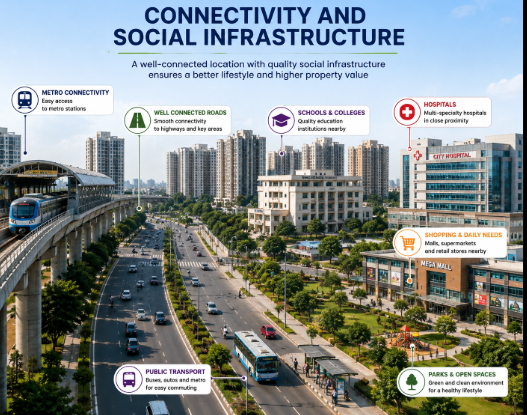
4. Examine Social Infrastructure
People do not buy homes only for four walls.
They buy access to a lifestyle.
Important social infrastructure includes:
- Schools
- Colleges
- Hospitals
- Clinics
- Grocery stores
- Banks
- Restaurants
- Shopping centres
- Parks
- Gyms
- Places of worship
- Community facilities
For families, the quality and distance of schools may be especially important.
For older residents, hospitals and healthcare facilities can matter more.
For young professionals, public transport, restaurants, offices, and entertainment may have greater importance.
Therefore, the best location depends partly on the type of buyer or tenant you want to attract.
5. Study Employment Opportunities
One of the strongest drivers of housing demand is employment.
People generally prefer living reasonably close to their workplace or in locations with convenient transport to major employment hubs.
When a city develops:
- IT parks
- Corporate offices
- Manufacturing facilities
- Logistics hubs
- Financial districts
- Business parks
- Global Capability Centres
the surrounding residential areas may benefit from additional demand.
India’s office market has remained an important structural driver of real estate activity. Knight Frank reported record office leasing of 86.4 million sq ft in 2025 across its tracked markets, with Global Capability Centres accounting for a significant share of annual absorption.
For investors, this means it can be useful to study where jobs are being created, not just where property is currently cheap.
6. Compare Property Prices Carefully
A property being cheaper than neighbouring areas does not automatically make it a bargain.
Suppose Area A has apartments selling for ₹8,000 per sq. ft., while Area B has apartments selling for ₹5,000 per sq. ft.
Area B may look attractive.
But ask why it is cheaper.
Possible reasons could include:
- Poor connectivity
- Limited infrastructure
- Low rental demand
- Older buildings
- Legal complications
- Poor construction
- Flooding problems
- Limited employment nearby
- Oversupply of properties
Instead of asking:
“Where can I buy the cheapest property?”
ask:
“Where am I getting the best value for the price?”
That is a much better investment question.
7. Understand Rental Demand
If your investment strategy includes rental income, study the rental market before buying.
Check:
- Average monthly rent
- Vacancy periods
- Tenant profile
- Rental demand
- Maintenance costs
- Nearby competing properties
- Furnished versus unfurnished demand
For example, a two-bedroom apartment near a major employment hub may have stronger rental demand than a larger apartment in an isolated location.
Do not estimate rental income based only on what a property agent tells you.
Speak with local landlords and property managers where possible, and compare actual listings.
8. Calculate Rental Yield
Rental yield gives investors a basic idea of how much annual rental income a property generates compared with its cost.
A simple formula is:
Rental Yield = Annual Rent ÷ Property Cost × 100
For example, if a property costs ₹60 lakh and generates ₹20,000 per month in rent:
Annual rent = ₹20,000 × 12 = ₹2.4 lakh.
Approximate gross rental yield:
₹2.4 lakh ÷ ₹60 lakh × 100 = 4%
But this is only a basic calculation.
The actual return can be lower after considering:
- Maintenance
- Property tax
- Repairs
- Vacancy
- Brokerage
- Insurance
- Loan interest
- Society charges
- Property management costs
Therefore, investors should calculate net returns, not just gross rent.
9. Think About Capital Appreciation
Capital appreciation means an increase in the property’s value over time.
Several factors can support appreciation:
- Better infrastructure
- Increasing employment
- Population growth
- Limited land availability
- Strong buyer demand
- Improving connectivity
- Better social infrastructure
- Quality development
- Rising household incomes
But appreciation is never guaranteed.
An investor should be cautious about statements such as:
“This property will definitely double in two years.”
No legitimate investment analysis can guarantee a specific future property price.
A better approach is to examine historical prices, current demand, upcoming infrastructure, competing supply, and broader economic conditions.
10. Study Supply and Demand
A location can have excellent infrastructure and still perform poorly if too many similar properties are being built.
Imagine an area where 20,000 new apartments are planned but there are not enough buyers or tenants.
Investors may face:
- Longer selling periods
- Rental competition
- Lower-than-expected rent
- Discounts from developers
- Higher vacancy
- Slower appreciation
Therefore, study both sides:
Demand: How many people want the property?
Supply: How many similar properties are available or coming?
A healthy investment usually has a reasonable balance between the two.
11. Check the Developer’s Reputation
If you are purchasing from a developer, do not evaluate only the brochure.
Research:
- Previous projects
- Construction quality
- Delivery history
- Customer complaints
- Financial strength
- Project approvals
- Litigation history where relevant
- Maintenance standards
- Reputation among existing buyers
A beautiful marketing campaign does not guarantee a good project.
Try to visit completed projects by the same developer.
Speak with existing residents if possible.
This can provide practical information that advertisements may not show.
12. Verify Legal Documents
Legal due diligence is essential before buying property.
Depending on the type and location of the property, relevant documents may include:
- Title documents
- Sale deed
- Previous ownership documents
- Encumbrance information
- Approved building plans
- Relevant development permissions
- Tax receipts
- Possession-related documents
- Society or association documents
- Applicable RERA registration and project information
For larger transactions or properties with complicated ownership history, consult a qualified property lawyer.
Do not rely only on verbal assurances from a seller, broker, or developer.
Never make a major property payment before you understand the legal status of the property.
“
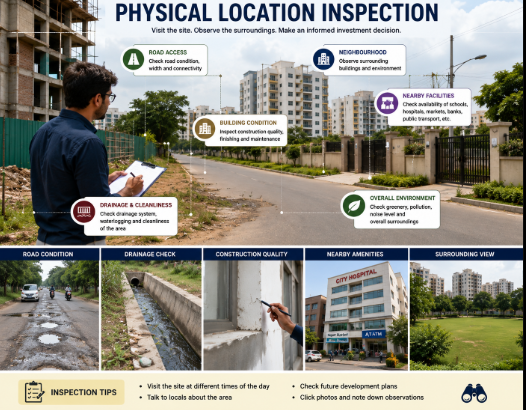
13. Visit the Property More Than Once
A single visit is not enough.
Try to visit:
- During the morning
- During evening peak hours
- On a weekend
- During or after rainfall where practical
Look for:
- Traffic
- Noise
- Waterlogging
- Drainage
- Street lighting
- Road access
- Parking
- Construction activity
- Pollution
- Safety concerns
- Neighbourhood cleanliness
A property can look completely different at 10 a.m. on a Sunday compared with 7 p.m. on a weekday.
14. Check Water and Drainage
This is especially important in areas experiencing rapid development.
Ask:
- Does the area experience waterlogging?
- Is drainage adequate?
- Is water supply reliable?
- What is the groundwater situation?
- Are sewage systems developed?
- Has the neighbourhood experienced flooding?
Do not ignore these issues simply because the apartment looks attractive.
Problems with water, drainage, or access can affect both rental demand and resale value.
15. Consider Safety and Quality of Life
Investors often focus heavily on price and forget everyday living conditions.
Check:
- Street lighting
- Road conditions
- Traffic
- Pedestrian access
- Local environment
- Noise levels
- Security arrangements
- Emergency services
- General cleanliness
A safe and convenient neighbourhood can be more attractive to tenants and families.
16. Understand Your Investment Goal
There is no single “best property” for every investor.
Your goal could be:
Goal 1: Capital Appreciation
You may focus on developing locations with strong infrastructure and employment growth.
Goal 2: Rental Income
You may prioritise locations near offices, universities, hospitals, transport hubs, and established neighbourhoods.
Goal 3: Retirement
You may prefer a peaceful area with hospitals, essential services, good connectivity, and lower maintenance requirements.
Goal 4: Commercial Investment
You may focus on footfall, business activity, accessibility, parking, and tenant demand.
Always match the property with your objective.
17. Do Not Ignore Total Purchase Cost
The advertised property price is not always the final amount you will pay.
Your budget may need to include:
- Property price
- Stamp duty
- Registration charges
- Brokerage
- Legal fees
- Loan processing charges
- Interior work
- Parking charges where applicable
- Maintenance deposits
- Society charges
- Repairs
- Moving expenses
- Taxes and other applicable costs
Before buying, prepare a complete budget.
A property that appears affordable at first may become expensive after all additional costs are included.
18. Be Careful With High Home Loans
Leverage can increase purchasing power, but it can also increase risk.
Before taking a loan, calculate:
- Down payment
- EMI
- Loan tenure
- Interest cost
- Expected rental income
- Monthly household expenses
- Emergency savings
Do not assume that rent will always cover your EMI.
There may be periods when:
- The property is vacant
- Repairs are required
- Rent falls
- Interest costs change
- Your personal income changes
A financially comfortable investment is usually safer than buying the maximum property a lender is willing to finance.
19. Consider Different Indian Markets
India is not one single real estate market.
Different cities have different drivers.
For example:
- Bengaluru has strong technology and office-sector demand.
- Hyderabad has significant technology, business, and infrastructure growth.
- Mumbai has limited land availability and strong employment demand but high entry prices.
- Pune has major IT, manufacturing, education, and employment centres.
- Chennai has industrial, automobile, technology, and office-sector activity.
- Delhi-NCR has multiple employment centres, infrastructure projects, and diverse residential markets.
These are broad observations, not guarantees of future returns.
Within each city, performance can vary significantly from one neighbourhood to another.
That is why investors should study the micro-market, not only the city.
20. Look Beyond the Main City
Sometimes the best opportunity is not in the established centre of a city.
Growing suburbs and peripheral areas can offer:
- Lower entry prices
- Larger homes
- New infrastructure
- New employment centres
- Better road connectivity
- New schools and hospitals
But peripheral investment comes with additional risk.
Ask whether the proposed development is actually happening.
A location can remain “upcoming” for many years.
Investors should distinguish between:
Real growth and marketing-driven future growth.
21. Understand Market Cycles
Real estate does not move upward in a straight line.
Markets can experience:
- Strong growth
- Stable periods
- Slower sales
- Price corrections
- Increased inventory
- Recovery
This is normal.
Recent market data already shows differences between housing segments. In 2025, overall residential sales across the top eight markets were slightly lower than in 2024, while premium housing continued to attract strong demand.
This is an important lesson:
Do not judge the entire Indian real estate market from one segment or one city.
22. Watch Affordability
One of the biggest questions for 2026 is whether property prices remain affordable for ordinary buyers.
When prices rise faster than incomes, buyers may:
- Choose smaller homes
- Move farther from city centres
- Delay purchases
- Increase loan periods
- Prefer rental housing
This can influence future demand.
Investors should therefore compare property prices with local salaries, rents, employment opportunities, and household purchasing power.
23. Think About Exit Strategy
Before buying, ask:
“Who will buy this property from me later?”
This is one of the most overlooked questions in real estate investing.
A property may look attractive today but be difficult to sell later.
Consider your likely future buyer:
- Family
- Working professional
- Investor
- Business owner
- Developer
- Retiree
Properties with a broader potential buyer base can sometimes offer better liquidity than highly specialised properties.
24. Common Mistakes Real Estate Investors Should Avoid
Mistake 1: Buying Only Because the Price Is Low
Cheap property is not necessarily good property.
Mistake 2: Believing Guaranteed Returns
Real estate returns cannot be guaranteed.
Mistake 3: Ignoring Legal Checks
A property with legal complications can create years of problems.
Mistake 4: Depending Completely on the Broker
Brokers can provide useful local information, but investors should independently verify important claims.
Mistake 5: Ignoring Rental Demand
A property may appreciate slowly and also produce weak rental income.
Mistake 6: Buying Without Visiting
Online photos do not show everything.
Mistake 7: Over-Borrowing
A high EMI can turn a good property into a financial burden.
Mistake 8: Ignoring Future Supply
Too many new projects can increase competition.
Mistake 9: Focusing Only on the Building
The surrounding location matters enormously.
Mistake 10: Expecting Quick Profits
Property is generally more suitable for investors who can take a longer-term view.

Real Estate Investment Checklist for 2026
Before making a final decision, ask yourself:
- Is the location already in demand?
- Is the area connected to major roads and public transport?
- Are schools and hospitals easily accessible?
- Are employment opportunities available nearby?
- Is rental demand strong?
- Is the purchase price reasonable compared with similar properties?
- Have I checked comparable properties?
- Have I researched future infrastructure?
- Have I checked the developer’s track record?
- Have I verified the property’s legal documents?
- Have I checked applicable RERA information?
- Have I visited the property personally?
- Have I checked drainage and water supply?
- Have I calculated the complete purchase cost?
- Can I comfortably afford the EMI?
- Have I considered maintenance and vacancy costs?
- Do I have an emergency fund?
- Do I know my expected rental yield?
- Do I have a clear exit strategy?
- Am I prepared to hold the property for several years?
If you cannot answer several of these questions, take more time before investing.
How to Choose the Best Location: A Simple Formula
For a quick comparison between locations, investors can score each area from 1 to 5 for:
| Factor | Score |
|---|---|
| Connectivity | /5 |
| Employment opportunities | /5 |
| Schools and hospitals | /5 |
| Rental demand | /5 |
| Current price value | /5 |
| Future infrastructure | /5 |
| Supply and demand | /5 |
| Safety and quality of life | /5 |
| Legal/project confidence | /5 |
| Resale potential | /5 |
This does not guarantee investment success, but it forces you to compare locations logically rather than emotionally.
What Does E-E-A-T Mean for a Real Estate Article?
For real estate content to be trustworthy, readers should be able to understand who is providing the information, what evidence supports important claims, and what limitations apply.
A strong real estate article should:
- Use current and credible market sources.
- Clearly separate facts from opinions.
- Avoid promises of guaranteed returns.
- Explain risks as well as opportunities.
- Encourage legal and financial due diligence.
- Use realistic examples.
- Keep information easy to understand.
- Update market statistics when conditions change.
This article uses current market research to provide context, but it should not replace professional legal, tax, financial, or property-specific advice.
Final Verdict: Is Property a Good Investment in India in 2026?
Yes, property can still be a good investment in India in 2026—but investors should be selective.
The current market provides reasons for optimism. India’s residential sector has shown resilience, and strong economic activity, employment centres, infrastructure development, and housing demand can continue to support selected locations. Knight Frank’s 2026 research also points to a supportive overall outlook while highlighting changing market conditions and differences between property segments.
However, a strong national market does not mean every property will appreciate.
The most important lesson for investors is simple:
Do not buy a property only because it is available. Buy because the location, price, demand, legal position, and long-term investment case make sense.
A good location should ideally have strong connectivity, employment opportunities, social infrastructure, rental demand, and credible future development.
At the same time, investors should maintain enough financial flexibility to handle unexpected costs, vacancies, interest-rate changes, and slower-than-expected appreciation.
Real estate can create wealth, but it rewards research, patience, and disciplined decision-making.
Before signing a property agreement, compare multiple options, visit the location personally, verify important documents, calculate the complete cost, and seek qualified professional advice when necessary.
Key Takeaways
- Location should be your first major consideration.
- Connectivity can support both rental and resale demand.
- Employment growth can create long-term housing demand.
- Schools, hospitals, markets, and public transport improve liveability.
- Do not confuse a low price with a good investment.
- Study supply as well as demand.
- Calculate rental yield and total ownership costs.
- Verify legal documents before making major payments.
- Research the developer before buying an under-construction property.
- Visit the location personally.
- Avoid excessive borrowing.
- Have a clear exit strategy.
- Do not believe guaranteed-return promises.
- Compare the micro-market, not just the city.
- Think long term rather than expecting quick profits.
A Simple Rule for Investors
Good property + good location + fair price + strong demand + proper due diligence = a stronger real estate investment decision.
No investment is risk-free. But by choosing the location carefully and checking the numbers and documents before buying, investors can greatly improve their chances of making a sensible property investment in India in 2026.