
Buying vs Renting a Property: Which Is Better in 2026?
Choosing between buying vs renting a property is one of the biggest financial decisions many people make. A home is not only a place to live. It can also be a long-term financial commitment, while renting can give you flexibility and lower short-term responsibility.
In 2026, the right choice depends on your income, savings, job stability, family plans, preferred location, property prices, rent levels and how long you expect to stay in one place.
There is no universal answer that says buying is always better or renting is always better.
For some people, buying a home can provide stability and long-term ownership. For others, renting can be more practical because it requires less money upfront and makes moving easier.
Current financial conditions also matter. The Reserve Bank of India has kept the policy environment relatively stable recently, while market expectations around interest rates can still change. This means home-loan borrowers should not make a decision based only on today’s EMI.
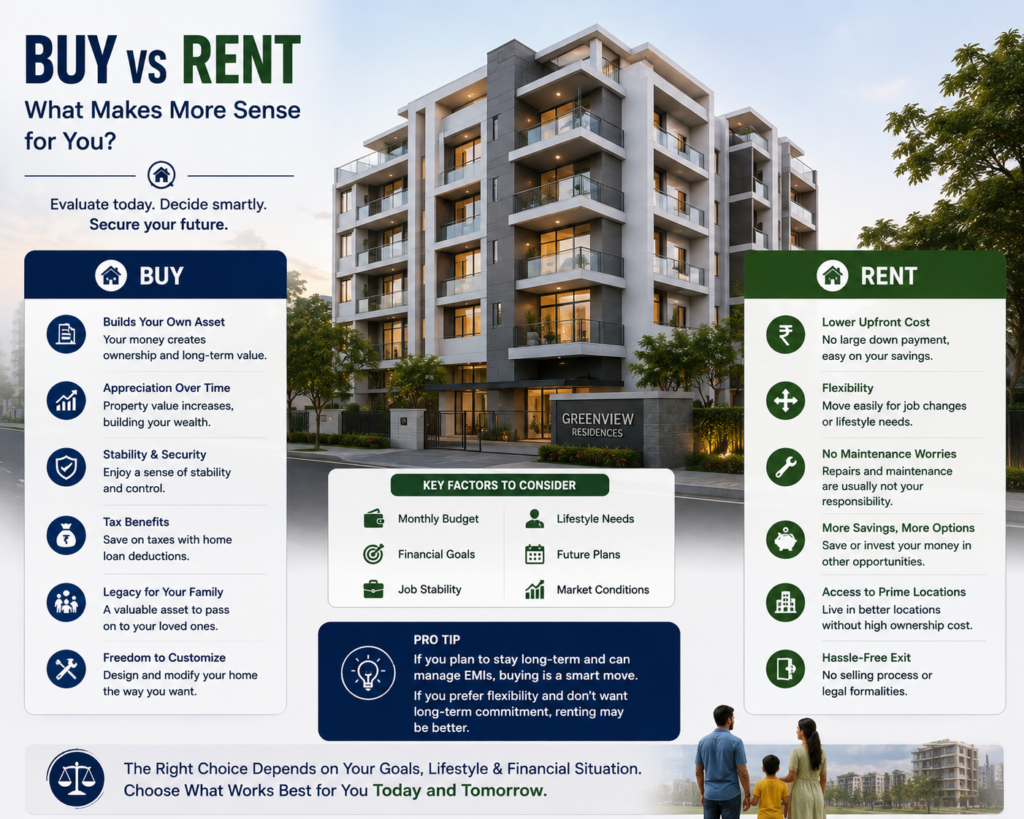
Buying may be better if:
- You have a stable income.
- You have enough savings for the down payment and other buying costs.
- You plan to stay in the property for many years.
- You want long-term ownership.
- You are comfortable with EMI and maintenance expenses.
- The property is legally verified and suitable for your needs.
- Buying the property will not put too much pressure on your monthly budget.
Renting may be better if:
- You may move because of your job or business.
- You have limited savings.
- You are not sure where you want to settle.
- The purchase price is very high compared with local rent.
- You want flexibility.
- You want to invest your available money elsewhere.
- A large home loan would make your finances uncomfortable.
The most important point: Do not compare only rent with EMI. A proper comparison should include the down payment, interest, maintenance, taxes, registration-related costs, insurance, opportunity cost and expected property value.
A recent personal-finance discussion highlighted exactly this issue: comparing a ₹50,000 EMI with ₹35,000 rent can be misleading because home ownership has several additional costs.
What Does Buying a Property Mean?
When you buy a property, you become its owner after completing the legal and financial process.
You may purchase a property using:
- Your own savings
- A home loan
- A combination of savings and a home loan
Buying usually requires a significant amount of money at the beginning. You may need to arrange a down payment along with registration, stamp duty, legal checks, loan-related charges, interiors and other expenses.
The benefit is that you are building ownership in an asset rather than paying rent to a landlord.
However, ownership also means responsibility.
If the property needs repairs, maintenance or renovation, the owner normally has to bear those costs.
What Does Renting a Property Mean?
Renting means you pay the property owner a fixed amount, usually every month, in exchange for the right to live in the property.
Depending on the rental agreement, the tenant may also have responsibilities for certain utility bills, minor repairs or maintenance.
The biggest advantage of renting is flexibility.
If you change your job, start a business, move to another city or simply want a different neighbourhood, moving from a rented property is generally easier than selling a house.
Renting also requires much less money upfront compared with buying a property.
Buying vs Renting: Key Differences
| Factor | Buying | Renting |
|---|---|---|
| Initial cost | High | Usually lower |
| Monthly payment | EMI + other ownership costs | Rent + applicable charges |
| Ownership | Yes | No |
| Flexibility | Lower | Higher |
| Maintenance | Mostly owner’s responsibility | Depends on agreement |
| Property appreciation | Possible benefit to owner | No direct benefit |
| Market risk | Owner carries it | Landlord generally carries property-price risk |
| Long-term stability | High | Depends on rental arrangement |
| Moving | More difficult | Usually easier |
| Loan requirement | Often required | Not required |
| Wealth creation | Possible through property ownership | Depends on how savings are invested |
| Legal responsibility | Higher | Lower |
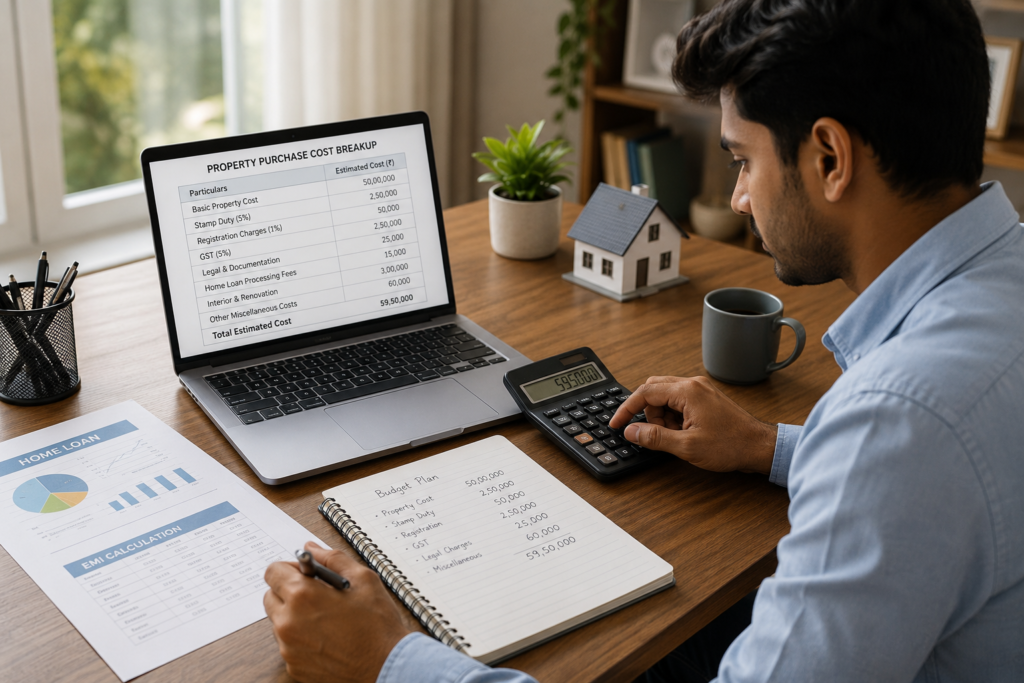
1. Cost of Buying a Property in 2026
One of the biggest mistakes buyers make is looking only at the property price.
For example, suppose a property costs ₹60 lakh.
You should not assume that ₹60 lakh is your total cost.
There may also be:
- Down payment
- Home-loan interest
- Stamp duty
- Registration expenses
- Brokerage, where applicable
- Legal verification
- Loan processing charges
- Insurance
- Maintenance
- Society or association charges
- Interior work
- Repairs
- Property taxes, where applicable
- Moving expenses
Therefore, buyers should calculate the total cost of ownership rather than focusing only on the advertised property price.
2. Cost of Renting a Property in 2026
Renting appears simpler because the biggest regular expense is the monthly rent.
However, renters should also consider:
- Security deposit
- Monthly rent
- Maintenance charges
- Utility bills
- Brokerage, where applicable
- Moving costs
- Rent increases
- Furnishing costs
- Renewal charges, if applicable
The exact terms depend on the rental agreement.
One advantage is that the renter generally does not need to arrange a large home-loan down payment.
This can leave more money available for emergency savings, education, business, investments or other financial goals.
3. The Importance of Your Time Horizon
Your expected length of stay is one of the most useful factors when deciding whether to buy or rent.
If you plan to stay for a short period
Renting may make more sense.
For example, if you expect to move within two or three years, buying can involve substantial transaction costs. Selling the property later may also take time.
If you plan to stay for many years
Buying may become more attractive.
A long ownership period gives you more time to use the property and potentially benefit from appreciation.
However, property appreciation is never guaranteed.
A property’s future value depends on factors such as location, infrastructure, demand, supply, economic conditions and the quality of the property.
4. Monthly EMI vs Monthly Rent
This is where many people make a mistake.
Suppose:
Rent = ₹30,000 per month
and
EMI = ₹35,000 per month
It may appear that buying is only ₹5,000 more expensive.
But that comparison is incomplete.
A homeowner may also have:
- Maintenance costs
- Property-related taxes
- Insurance
- Repairs
- Society charges
- Interest on the home loan
- Opportunity cost of the down payment
The renter may instead keep the difference in savings or investments.
Therefore, the correct question is not:
“Is my EMI higher or lower than my rent?”
The better question is:
“What is my total cost of owning this property compared with the total cost of renting and investing the money I save?”
5. Down Payment: A Major Factor
Buying a property usually requires a substantial upfront contribution.
For example, if you purchase a property for ₹70 lakh and arrange ₹15 lakh from your own funds, you still need to consider the other purchase-related costs.
This is why buyers should avoid using all their savings for the down payment.
It is important to keep an emergency fund.
A good financial plan should allow you to continue paying your EMI even if you face:
- Temporary loss of income
- Unexpected medical or family expenses
- Business slowdown
- Job change
- Major home repairs
Buying a property should not leave you financially helpless after the transaction.
6. Home Loan Interest Matters
Home loans can make property ownership possible for many buyers, but interest can significantly increase the total amount paid over the loan period.
For example, a loan may look affordable based on the EMI, but over a long tenure, the total interest can be substantial.
RBI guidance explains that floating-rate loans can change when market interest rates change. Borrowers should therefore understand how changes in rates can affect EMI or loan tenure.
Before taking a home loan, compare:
- Interest rate
- Fixed or floating rate
- Loan tenure
- Processing fee
- Legal and technical charges
- Insurance requirements
- Prepayment rules
- Conversion or switching charges
- Total repayment amount
Do not select a loan simply because it offers the lowest advertised interest rate.
7. Tax Benefits of Buying
Home ownership can provide certain tax benefits depending on the taxpayer’s circumstances and the tax regime chosen.
The Income Tax Department’s current guidance lists deductions relating to housing-loan principal under Section 80C, subject to the applicable rules and combined limits. It also describes Section 24(b) interest deductions, including the ₹2 lakh limit for eligible self-occupied property under the old tax regime.
Tax rules can change, and eligibility depends on individual circumstances.
Therefore, buyers should check the current rules before including tax benefits in their affordability calculation.
Important: Never buy an expensive property only because someone tells you that you will “save tax.”
The tax benefit should be one part of the calculation, not the main reason for buying.
8. Benefits of Buying a Property
8.1 You Build Ownership
When you buy a home using a loan, part of your repayment goes toward reducing the principal.
Over time, you can build equity in the property.
This is different from rent, where your monthly payment generally gives you the right to occupy the property but does not give you ownership.
8.2 Long-Term Stability
Homeowners generally have greater control over their living situation.
You do not have to worry about a landlord deciding to sell the property or refusing to renew the rental arrangement, subject to applicable laws and agreements.
This can be especially valuable for families who want to stay in one area for many years.
8.3 Potential Property Appreciation
If the property value increases, the owner may benefit from that appreciation.
For example, a property purchased for ₹60 lakh could be worth more in the future.
But this is not guaranteed.
Property prices can remain flat or even fall in some markets.
So, never treat future appreciation as guaranteed income.
8.4 Freedom to Modify the Home
Owners generally have more freedom to renovate or customise their property, subject to building rules, society rules and applicable permissions.
You may be able to:
- Change interiors
- Upgrade the kitchen
- Renovate bathrooms
- Add furniture
- Improve lighting
- Create storage
- Redesign rooms
Renters usually have more restrictions.
9. Disadvantages of Buying
Buying is not automatically the better financial decision.
High upfront cost
You need significant savings for the initial purchase.
Long-term loan commitment
A home loan can continue for many years.
Maintenance responsibility
Repairs and maintenance become your responsibility.
Less flexibility
Selling a property can take time.
Market risk
Property prices can decline or remain stagnant.
Opportunity cost
Money used for a down payment cannot be used for other investments or goals.
Emotional decisions
People sometimes buy properties because of emotions rather than financial logic.
For example, “This house looks beautiful” is not enough reason to take a large loan.
10. Benefits of Renting a Property
10.1 Lower Initial Financial Burden
Renting normally requires significantly less upfront capital than purchasing.
You may need a security deposit and other initial expenses, but you do not need to arrange a large property down payment.
10.2 Greater Flexibility
Renting can be useful for people who:
- Change jobs frequently
- Work in different cities
- Are starting their careers
- Are unsure where they want to settle
- Expect their family size to change
You can usually change homes more easily than you can sell and buy properties.
10.3 Easier Access to Premium Locations
Buying a property in a prime location may be too expensive for some families.
Renting may allow them to live in a better location without taking a very large home loan.
For example, a person may not be able to buy a ₹1.5 crore property in a premium neighbourhood but may be able to afford its rent.
10.4 Lower Maintenance Responsibility
Depending on the rental agreement, major structural or property-related repairs may be the owner’s responsibility.
This can make monthly financial planning easier.
11. Disadvantages of Renting
Renting also has disadvantages.
No ownership
Your rent does not normally create ownership of the property.
Rent can increase
Your rent may increase when the agreement is renewed, depending on the terms.
Less control
You may need the landlord’s permission for certain changes.
Moving risk
The owner may decide to sell or change the rental arrangement.
Long-term rental expense
If you rent for decades without investing your savings effectively, you may miss an opportunity to build assets.
12. When Renting May Be Better Than Buying
Renting can be a smart choice when your current lifestyle is uncertain.
For example, imagine you have recently started a job in another city.
You are not sure whether you will remain there for five years.
Buying a house immediately may not be practical.
Instead, you could rent for a few years while:
- Building your emergency fund.
- Increasing your income.
- Improving your credit profile.
- Learning about the local property market.
- Saving for a future down payment.
- Understanding which neighbourhood suits you.
This gives you time to make a better buying decision later.
13. When Buying May Be Better Than Renting
Buying may be suitable when:
- Your income is stable.
- You have sufficient savings.
- Your EMI is affordable.
- You have an emergency fund.
- You plan to stay for a long period.
- You understand the property’s legal documents.
- The location suits your long-term plans.
- You have compared several properties.
- You have compared different home-loan offers.
The RBI itself advises borrowers to compare lenders and look beyond the EMI, including fees, loan terms, interest type and other costs.
14. Check Your Financial Health Before Buying
Before buying a property, ask yourself these questions:
Question 1: Is my income stable?
If your income is uncertain, a large EMI can become stressful.
Question 2: Do I have emergency savings?
Do not use every rupee of your savings for the property.
Question 3: Can I afford the EMI comfortably?
Your home loan should leave enough money for daily expenses, savings and emergencies.
Question 4: Do I have other loans?
Credit-card debt, personal loans and other EMIs should be included in your calculation.
Question 5: Can I afford the property if interest rates rise?
Floating-rate borrowers should consider the possibility of changes in borrowing costs.
15. Legal Checks Before Buying
Financial affordability is only one part of property buying.
You should also verify the property carefully.
Important checks may include:
- Title documents
- Ownership history
- Encumbrances
- Approved building plans
- Land-use permissions
- Completion or occupancy documents where applicable
- Property tax records
- Development permissions
- Sale agreement
- Builder documentation
- RERA registration, where applicable
For resale properties, RBI’s consumer guidance advises buyers to verify documents, check title and obtain relevant records rather than relying on photocopies or verbal assurances.
Image Space:
[Insert image here: Indian homebuyer checking property documents with a lawyer]
16. Do Not Ignore Location
Location can be more important than the size of the house.
Before buying or renting, consider:
- Distance from work
- Schools
- Hospitals
- Public transport
- Roads
- Markets
- Safety
- Future infrastructure
- Water supply
- Parking
- Noise levels
- Neighbourhood quality
A cheaper property in a poor location may not always be a better deal.
Similarly, an expensive property in an excellent location may not be affordable for your budget.
The best property is one that fits both your financial capacity and lifestyle.
17. A Simple Example: Buying vs Renting
Let’s take a hypothetical example.
Suppose:
Property price: ₹60 lakh
Monthly rent for a similar property: ₹25,000
Home loan: ₹45 lakh
Down payment: ₹15 lakh
A buyer must consider the EMI on ₹45 lakh.
But the buyer also needs to consider:
- Interest on the loan
- Registration-related costs
- Maintenance
- Property taxes where applicable
- Insurance
- Repairs
- Opportunity cost of ₹15 lakh
The renter pays rent but keeps the ₹15 lakh available for other purposes, subject to the rental deposit and other costs.
If the renter invests the money responsibly, those investments may grow.
On the other hand, the buyer may build home equity and potentially benefit from property appreciation.
This example shows why there is no simple answer.
18. A Useful Rule: Compare Total Costs
Instead of comparing:
Rent vs EMI
compare:
Renting
Rent + maintenance/other tenant costs + moving costs + opportunity cost/return on savings
against
Buying
EMI + maintenance + taxes + insurance + purchase costs + opportunity cost of down payment
Then consider:
Property value/equity created over the same period.
This gives you a much more realistic picture.
19. Common Mistakes to Avoid
Mistake 1: Buying because “rent is wasted money”
Rent is not necessarily wasted.
You are paying for housing, flexibility and the ability to use a property without purchasing it.
Mistake 2: Taking the maximum loan offered by the bank
A bank’s eligibility is not the same as your comfortable budget.
Mistake 3: Using all savings for the down payment
Keep an emergency fund.
Mistake 4: Ignoring maintenance
Older properties can require significant repairs.
Mistake 5: Assuming prices will always rise
No investment provides guaranteed appreciation.
Mistake 6: Ignoring legal verification
A beautiful property can still have legal or documentation problems.
Mistake 7: Choosing a property only because of low EMI
A longer loan tenure can reduce monthly EMI but increase total interest.
Mistake 8: Ignoring future plans
A property that is perfect for a single person may not work for a growing family.
20. Buying vs Renting: Decision Guide for 2026
Use this simple guide.
Choose buying if most of these statements are true:
- I have stable income.
- I have sufficient savings.
- I have an emergency fund.
- I can comfortably afford the EMI.
- I plan to stay in the area for many years.
- I have checked the property’s legal documents.
- I have compared home-loan offers.
- I understand the total purchase cost.
- The property fits my long-term needs.
- Buying will not stop me from meeting other financial goals.
Consider renting if most of these statements are true:
- I may move within a few years.
- My job or business location is uncertain.
- I do not have enough savings for a comfortable purchase.
- Buying would require a very large EMI.
- I want to live in a premium area that is too expensive to buy.
- I want financial flexibility.
- I am still deciding where to settle.
- I have other important financial goals.
- Comparable rent is significantly more affordable.
- I can invest my savings responsibly.
21. Expert Tip: Do Not Rush the Decision
Buying a property is a major financial commitment.
Do not purchase because:
- A salesperson says prices will rise tomorrow.
- Your friends have purchased homes.
- Your relatives say renting is a waste.
- You are afraid of missing out.
- Someone promises guaranteed appreciation.
Take time to compare properties, locations, loan offers and total costs.
RBI consumer guidance specifically recommends shopping around for home loans and comparing interest rates, fees, down-payment requirements and other terms before choosing a lender.
22. What Should First-Time Buyers Do in 2026?
First-time buyers should follow a step-by-step approach.
Step 1: Decide your budget
Calculate how much you can realistically spend.
Step 2: Build savings
Keep money aside for the down payment and other purchase costs.
Step 3: Maintain an emergency fund
Do not put your entire savings into the property.
Step 4: Check your credit profile
A stronger credit profile may help you obtain better loan terms, depending on the lender.
Step 5: Compare lenders
Do not automatically accept the builder’s recommended lender.
Step 6: Research locations
Visit the area at different times of the day.
Step 7: Verify the property
Get appropriate legal and technical checks.
Step 8: Calculate the full cost
Include all major expenses.
Step 9: Negotiate
Compare similar properties and negotiate where possible.
Step 10: Read every document
Never sign documents you do not understand.
23. Frequently Asked Questions
Is buying a house better than renting in 2026?
Not for everyone. Buying may be better for people with stable income, sufficient savings and long-term plans. Renting may be better for people who value flexibility or are not ready for a large financial commitment.
Is rent cheaper than EMI?
It can be, but this depends on the property and location. More importantly, EMI should not be compared with rent alone. Ownership has several additional costs.
Is buying a property a good investment?
A property can become a valuable long-term asset, but appreciation is not guaranteed. Location, property quality, purchase price, financing cost and market conditions all matter.
How long should I plan to stay before buying?
There is no fixed number that works for everyone. However, if you expect to move very soon, renting may be more practical because buying and selling involve significant costs and effort.
Should I use all my savings for a down payment?
Generally, it is risky to use all your savings. You should consider keeping adequate emergency funds and money for other important financial needs.
Should I choose a fixed or floating home loan?
Both have advantages and disadvantages. Fixed rates can provide greater payment certainty, while floating rates can move up or down with the applicable benchmark. Understand the lender’s terms before choosing. RBI guidance explains these differences and the potential impact of changing rates.
Can renters build wealth?
Yes. Renting does not prevent wealth creation. A renter can potentially invest the money saved from not buying a property. The important factor is whether the person actually saves and invests the difference responsibly.
Can homeowners lose money?
Yes. Property values are not guaranteed to increase. Owners can also face maintenance expenses, transaction costs and periods when the property is difficult to sell.
24. Final Verdict: Buying vs Renting in 2026
So, buying vs renting a property—which is better in 2026?
The answer depends on your personal situation.
Buying can be better if you are financially stable, have enough savings, want long-term stability and plan to stay in the property for many years.
Renting can be better if you need flexibility, are unsure about your future location, have limited savings or would have to take an uncomfortable loan to buy.
The smartest decision is not necessarily the one that gives you a house immediately. It is the one that keeps your finances healthy while supporting your long-term goals.
Before buying, calculate the complete cost of ownership. Before renting, consider what you will do with the money you are not putting into a home.
Most importantly, do not make the decision based only on emotion, social pressure or a simple EMI-versus-rent comparison.
The Best Property Decision Is One You Can Afford Comfortably and Sustain for the Long Term.

Key Takeaways
- Buying and renting can both be smart choices in 2026.
- Do not compare rent with EMI alone.
- Calculate the complete cost of buying a property.
- Keep an emergency fund before taking a large home loan.
- Consider your expected length of stay.
- Renting provides more flexibility.
- Buying provides ownership and potential long-term equity.
- Property appreciation is never guaranteed.
- Compare different home-loan offers before borrowing.
- Understand fixed and floating interest rates.
- Check property documents before buying.
- Consider location, infrastructure and future needs.
- Do not use all your savings for a down payment.
- Do not buy only because someone says prices will rise.
- Choose the option that fits your income, savings, lifestyle and long-term goals.
Important Disclaimer
This article is for general educational and informational purposes. Property prices, rents, loan rates, tax rules and legal requirements can vary by location and individual circumstances. Tax benefits and home-loan rules may change, so buyers should verify current information with the relevant government authority, lender and qualified financial or legal professional before making a property purchase.
Content reviewed for: 2026 property-buying considerations, home-loan considerations and general Indian homebuyer guidance. Official RBI and Income Tax Department sources have been used for the regulatory and tax-related points above.