
Quick Summary
Buying a home is one of the biggest financial decisions a family can make. The right property should not only look attractive but should also match your family’s needs, budget, lifestyle, future plans, and safety requirements.
Before buying a property, consider important factors such as location, budget, property size, construction quality, legal documents, RERA registration, nearby facilities, connectivity, maintenance costs, and future value.
Do not make a decision only because a property has a beautiful interior or an attractive discount. A good home is one that your family can comfortably afford, legally own, safely live in, and enjoy for many years.
This guide explains how to choose the right property for your family in simple steps.
Key Points to Remember
- Set your total budget before starting your property search.
- Choose a location that suits your family’s daily routine.
- Think about your current and future family needs.
- Check the property’s carpet area instead of looking only at the advertised size.
- Visit the property more than once.
- Check construction quality and basic facilities.
- Verify ownership and other important property documents.
- Check RERA registration where applicable.
- Understand the complete cost, not just the property price.
- Compare different properties before making a final decision.
- Take professional legal advice when required.
- Never make a rushed decision because of sales pressure.
Introduction
Choosing a home for your family is more than simply finding a beautiful apartment, house, or plot. A property becomes part of your family’s everyday life. It is where children grow, parents spend time together, and important memories are created.
For this reason, how to choose the right property for your family is a question that deserves careful thought.
Many buyers start their search by looking at the property’s price, number of bedrooms, or appearance. These factors are important, but they are not enough. A property may look perfect during the first visit but may have problems with connectivity, documentation, maintenance costs, construction quality, or surrounding development.
The Indian real estate sector is also regulated by laws such as the Real Estate (Regulation and Development) Act, 2016 (RERA). The Ministry of Housing and Urban Affairs explains that RERA was introduced to improve transparency, accountability, and protection for home buyers. It also requires applicable real estate projects to be registered with the relevant state or Union Territory regulator.
Therefore, choosing the right property requires a combination of financial planning, practical research, physical inspection, and legal verification.
Let’s look at the most important factors step by step.
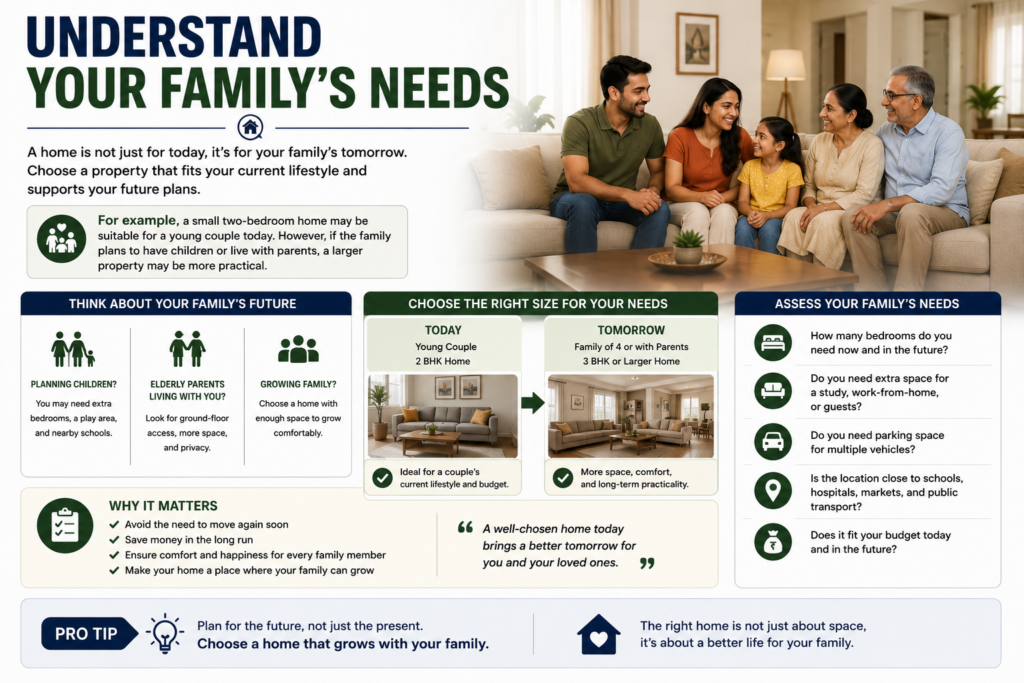
1. Understand Your Family’s Needs
The first step is to understand what your family actually needs.
Do not begin your property search by visiting random projects. First make a list of your requirements.
Ask yourself:
- How many people will live in the property?
- How many bedrooms do you need?
- Do you need an extra room for guests?
- Do you need a study room or work-from-home space?
- Are there elderly family members?
- Do you need a lift?
- Do you need parking?
- Do you have children who need a nearby school?
- Do you need access to hospitals?
- Do you prefer a quiet area or a busy location?
- Are you planning to have more children?
- Will you need more space in the next five to ten years?
For example, a small two-bedroom home may be suitable for a young couple today. However, if the family plans to have children or live with parents, a larger property may be more practical.
2. Set a Realistic Property Budget
Budget is one of the most important factors when buying a home.
Do not decide your budget based only on how much home loan you can get. Consider how much you can comfortably pay every month without putting unnecessary pressure on your family finances.
Your total property cost may include:
- Basic property price
- Stamp duty
- Registration charges
- GST, where applicable
- Brokerage
- Parking charges
- Maintenance deposits
- Club or amenity charges
- Legal verification fees
- Loan processing charges
- Interior and furnishing costs
- Moving expenses
- Other applicable charges
This means the final cost can be higher than the advertised property price.
Important Tip
Never calculate your budget using only the property price. Calculate the complete cost of buying and maintaining the property.
You should also keep an emergency fund instead of using all your savings for the property.
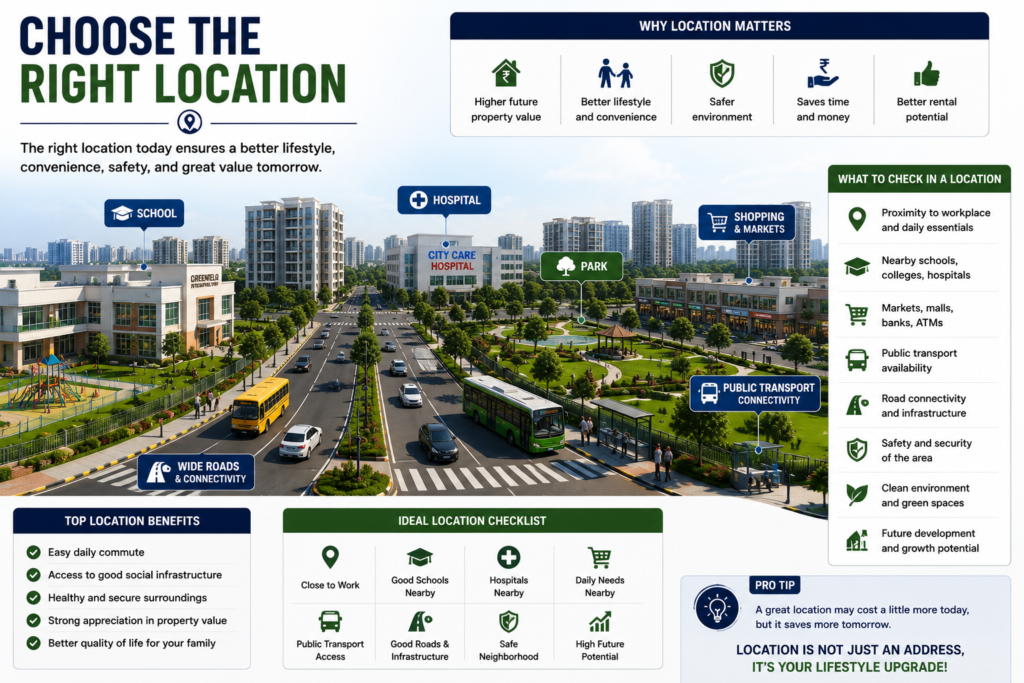
3. Choose the Right Location
Location can strongly affect your family’s quality of life and the property’s future value.
A property in a good location may make daily travel easier and provide better access to essential services.
Consider the distance from:
- Your workplace
- Children’s school
- Hospitals
- Grocery stores
- Markets
- Public transport
- Main roads
- Metro stations, where available
- Parks
- Banks and ATMs
- Restaurants and daily services
However, do not choose a location only because it is popular.
Think about your family’s actual routine.
For example, if you have school-going children, living close to a good school may be more useful than living close to a shopping mall.
4. Check Connectivity and Daily Travel Time
A property can be affordable and attractive but still become inconvenient if daily travel takes too long.
Before buying, check the actual travel time during peak hours.
Visit the location:
- In the morning
- In the evening
- During weekends
- During busy traffic hours
Check the condition of nearby roads and availability of public transportation.
Do not depend entirely on the travel time shown in a property advertisement.
A developer may say a metro station is “nearby,” but you should check the actual walking or driving distance.
Think about your family’s lifestyle five years from now as well.
Good connectivity can make everyday life easier and may also support the property’s long-term demand.
5. Decide Between Apartment, Independent House, or Plot
Every property type has different advantages and responsibilities.
Apartment
An apartment may be suitable for families who want facilities such as:
- Security
- Lift
- Parking
- Clubhouse
- Swimming pool
- Gym
- Children’s play area
- Community living
However, apartments usually involve regular maintenance charges and society rules.
Independent House
An independent house can provide more privacy and control over the property.
It may also offer:
- More open space
- Greater privacy
- More freedom for modifications
- Private parking
However, maintenance and security may require more personal responsibility.
Plot
Buying a plot gives you the option to construct a house according to your needs.
However, buyers need to carefully verify land ownership, land use, approvals, access roads, and other legal matters before purchasing.
The best choice depends on your family’s needs, budget, lifestyle, and long-term plans.
6. Choose the Right Property Size
Bigger is not always better.
A large property may have a higher purchase price, higher maintenance expenses, and greater costs for furnishing and upkeep.
Instead of asking only, “How big is the property?” ask:
“How much usable space does my family actually need?”
Consider:
- Number of bedrooms
- Living room size
- Kitchen space
- Bathrooms
- Storage
- Balcony
- Utility area
- Parking
- Natural light
- Ventilation
Also understand the difference between different area measurements used in property advertisements.
For apartments, pay attention to the carpet area, because it gives a clearer idea of the usable floor space.
RERA’s framework also emphasizes disclosure of carpet area to improve transparency for buyers.
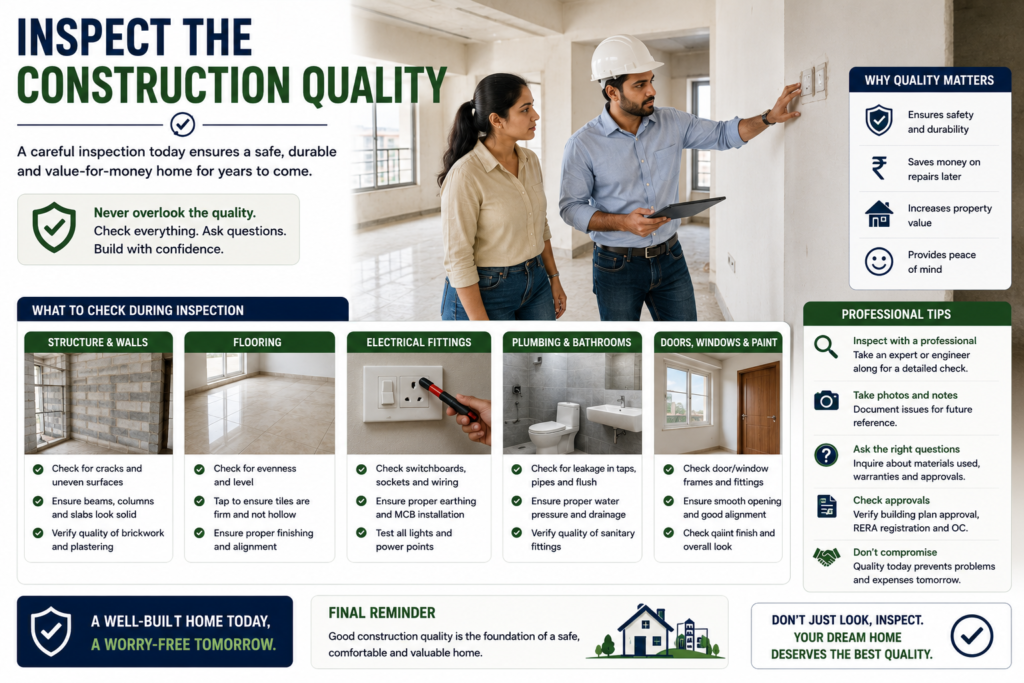
7. Check Construction Quality
Never buy a property based only on photographs or a sample apartment.
If the property is ready to move in, inspect it physically.
Look at:
- Walls
- Flooring
- Doors and windows
- Plumbing
- Electrical points
- Bathroom fittings
- Kitchen fittings
- Ceiling
- Water pressure
- Drainage
- Ventilation
- Natural lighting
Check for signs of:
- Dampness
- Water leakage
- Cracks
- Poor finishing
- Damaged fittings
- Poor drainage
If you are buying an under-construction property, review the specifications and approved plans carefully.
For expensive purchases, consider hiring a qualified professional for an independent inspection.
8. Check Natural Light and Ventilation
A beautiful property can still be uncomfortable if it does not receive enough natural light or fresh air.
During your visit, check:
- Which direction the rooms face
- Sunlight during different times of the day
- Window placement
- Cross ventilation
- Air movement
- Privacy from neighbouring buildings
Try visiting the property at different times if possible.
Good natural light and ventilation can make a home feel more comfortable and reduce dependence on artificial lighting and ventilation.
9. Check Safety and Security
Family safety should always be a priority.
For apartments and gated communities, check:
- Security guards
- CCTV cameras
- Entry and exit systems
- Visitor management
- Fire safety systems
- Emergency exits
- Lift safety
- Lighting in common areas
For independent houses, check:
- Street lighting
- Neighbourhood safety
- Road access
- Security arrangements
- Nearby emergency services
Ask residents about their actual experience instead of relying only on the developer’s sales team.
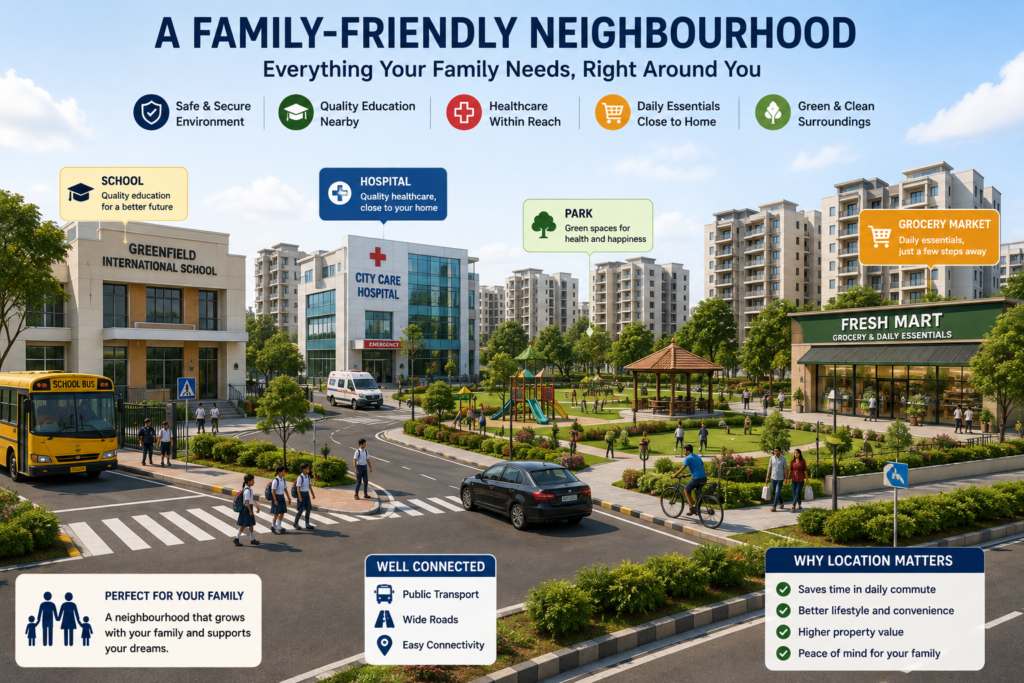
10. Check Schools, Hospitals and Other Facilities
For families with children or elderly parents, nearby essential facilities can be extremely important.
Check:
Schools
Look at the distance, transport options, and traffic conditions.
Hospitals
Check whether hospitals and clinics are easily accessible in an emergency.
Markets
A nearby grocery store or market can save time.
Parks
A nearby park can provide a useful space for children, walking, and family activities.
Public Transport
Check buses, metro connectivity, auto-rickshaws, and other transportation options.
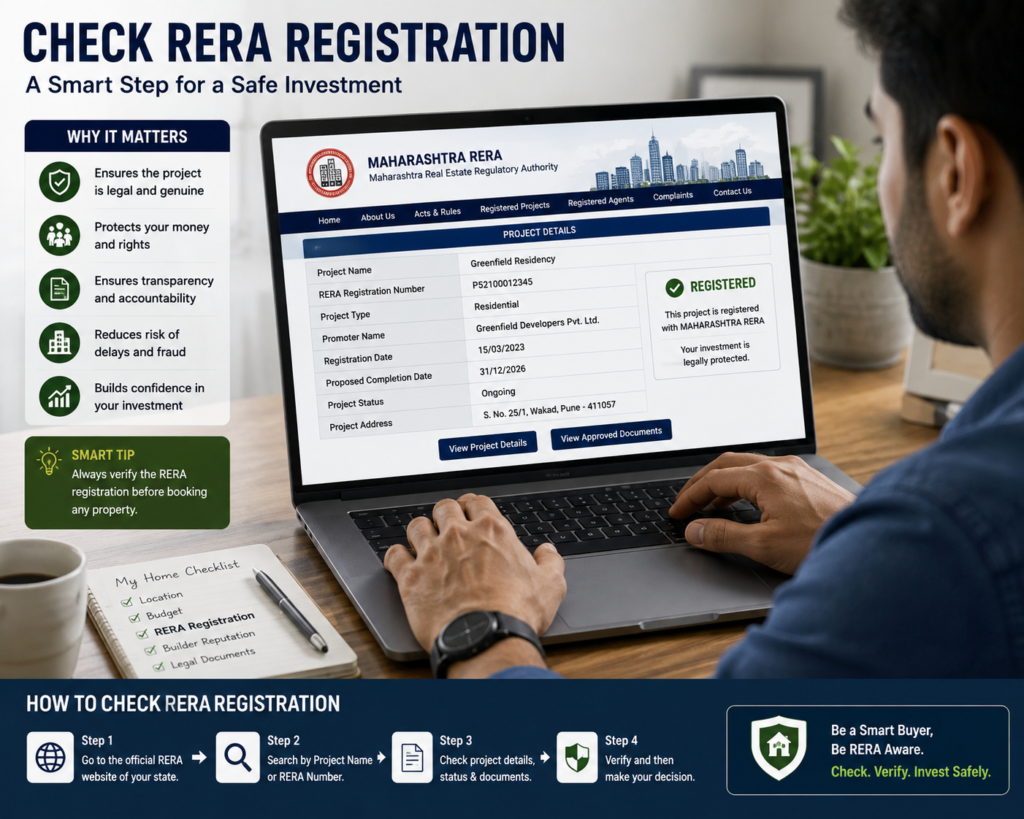
11. Verify RERA Registration
If you are buying a property in a project covered by RERA, check its registration with the relevant State or Union Territory Real Estate Regulatory Authority.
RERA provides a regulatory framework designed to improve transparency and protect home buyers. The Ministry of Housing and Urban Affairs states that applicable projects must be registered with the relevant regulator and that promoters cannot book or offer such projects for sale without registration.
The Ministry also provides a list of State and UT RERA authorities, including Delhi RERA and Haryana RERA.
Before paying money, verify:
- RERA registration number
- Promoter details
- Project details
- Approved plans
- Project completion information
- Declared specifications
- Other information available on the regulator’s portal
What if the Project Is Not Registered?
Do not immediately assume that every unregistered property is illegal because RERA has specific exemptions and applicability rules.
However, if the project appears to require registration but does not have it, treat this as a serious warning sign.
Ask the developer why registration is not available and verify the situation with the relevant state RERA authority or a qualified property lawyer before making a payment.
12. Verify Property Ownership and Legal Documents
Legal verification is one of the most important steps in property buying.
The documents required can vary depending on the type of property and location, but buyers commonly need to examine documents relating to:
- Ownership/title
- Previous transactions
- Sale deed
- Conveyance deed
- Approved building plans
- Land-use permissions
- Encumbrances
- Tax payments
- Possession
- Relevant approvals
- Project registration, where applicable
For government-owned or leasehold properties, additional requirements may apply.
For example, the Ministry of Housing and Urban Affairs’ Land and Development Office describes ownership documents such as lease deeds and conveyance deeds as documents establishing property ownership in its registration process.
Do not rely only on documents shown by the seller.
For a significant property purchase, have the documents reviewed by an independent property lawyer.
13. Check for Loans, Encumbrances and Disputes
Before buying, find out whether the property has any outstanding loan, mortgage, legal dispute, claim, or other encumbrance.
Ask for appropriate documents and records that can help establish the property’s legal status.
This is particularly important when buying a resale property.
A property may look perfect physically but still create problems if ownership or financial obligations are unclear.
Important Tip
Do not make a large payment simply because the seller says that the documents are “under process.” Verify important documents before committing significant money.
14. Compare Property Prices With the Local Market
Never assume that the quoted price is automatically a fair price.
Compare similar properties in the same area.
Look at:
- Price per square foot
- Carpet area
- Property age
- Floor
- Parking
- Amenities
- Location
- Construction quality
- Maintenance charges
- Developer reputation
- Nearby infrastructure
Try to compare at least three to five similar properties before making a decision.
Remember that two properties in the same city can have very different values because of location, connectivity, construction quality, and surrounding development.
15. Understand Home Loan and EMI Requirements
If you are taking a home loan, do not choose a property based only on the maximum loan amount offered by a bank.
Consider whether the EMI fits comfortably into your monthly budget.
Also understand:
- Interest rate
- Loan tenure
- Processing charges
- Prepayment conditions
- Insurance requirements
- Total repayment amount
- Down payment requirement
A longer loan tenure may reduce the monthly EMI but can increase the total interest paid over time.
Compare loan offers carefully and read the terms before signing.
16. Consider Future Family Needs
A property should not only work for your family today.
Think about the next five to ten years.
Ask:
- Will the family become larger?
- Will children need separate rooms?
- Will parents move in?
- Will you need a home office?
- Will you need additional parking?
- Will your lifestyle change?
- Will you continue working in the same area?
A slightly larger or better-planned property may sometimes be more practical than moving again after only a few years.
17. Research the Developer or Seller
If you are buying from a developer, research the developer’s background.
Look for:
- Previous projects
- Delivery history
- Construction quality
- Customer complaints
- Legal issues
- Project approvals
- RERA records
- Maintenance history
Do not judge a developer only by advertisements or social media.
Speak with people who already live in their completed projects if possible.
For resale properties, understand the seller’s ownership and reason for selling.
18. Visit the Property More Than Once
One property visit is rarely enough.
Visit at different times and on different days.
During your visits, observe:
- Traffic
- Noise
- Sunlight
- Water supply
- Parking
- Security
- Neighbourhood activity
- Mobile network
- Public transport
- Nearby construction
Also talk to existing residents.
They may tell you about practical issues that are not obvious during a sales visit.
19. Think About Maintenance Costs
Buying the property is only the beginning.
You will have ongoing expenses.
These may include:
- Society maintenance
- Electricity
- Water
- Repairs
- Property tax
- Security
- Parking
- Lift maintenance
- Clubhouse charges
- Home insurance
- Renovation
Before buying an apartment, ask the society or management about current maintenance charges and any major upcoming expenses.
A property with a slightly lower purchase price may become expensive if its regular maintenance costs are very high.
20. Check the Surrounding Area
The property itself is only one part of your future home.
Look at the surrounding neighbourhood.
Check:
- Road quality
- Drainage
- Cleanliness
- Street lighting
- Noise levels
- Pollution
- Traffic
- Nearby construction
- Waterlogging risk
- Waste management
- Commercial activity
Visit the area after rain if possible, especially if flooding or waterlogging is a known concern in that location.
21. Do Not Rush Because of Sales Pressure
Real estate sales teams may sometimes use phrases such as:
- “Only one unit left.”
- “Price will increase tomorrow.”
- “Offer ends today.”
- “Book immediately.”
- “Special discount for today.”
Do not allow sales pressure to replace proper research.
If you need time to verify documents, compare prices, or speak with your family and lawyer, take that time.
A home is a long-term financial commitment. A short-term discount should not make you ignore a serious legal or financial concern.
22. Get Professional Help When Needed
You do not have to handle every part of a property purchase alone.
Depending on the property and transaction, professional help may include:
- Property lawyer
- Chartered accountant
- Home-loan advisor
- Property inspector
- Architect
- Valuer
A professional can help identify issues that a normal buyer may miss.
This is particularly useful for high-value transactions, resale properties, plots, inherited properties, or properties with complicated documentation.
Professional verification may cost money, but it can help reduce the risk of a much larger financial loss.
A Simple Property-Buying Checklist
Before finalising your property, ask yourself:
- Does the property fit my family’s needs?
- Can I comfortably afford the total cost?
- Is the location suitable for my daily life?
- Are schools and hospitals accessible?
- Is the property well connected?
- Is the size suitable for my family?
- Is the construction quality satisfactory?
- Does the property have good light and ventilation?
- Are safety and security arrangements adequate?
- Have I checked RERA registration where applicable?
- Have I verified ownership and important legal documents?
- Have I checked for encumbrances or disputes?
- Have I compared similar properties?
- Have I calculated EMI and other costs?
- Have I considered future family needs?
- Have I visited the property more than once?
- Have I checked maintenance expenses?
- Have I spoken to existing residents where possible?
- Have I taken professional legal advice if necessary?
- Am I making the decision without unnecessary pressure?
Common Mistakes Home Buyers Should Avoid
Mistake 1: Buying Only Because of a Low Price
A low price does not always mean a good deal.
Investigate why the property is cheaper.
Mistake 2: Ignoring Legal Verification
Never assume that a property is legally safe simply because it is being advertised publicly.
Mistake 3: Looking Only at the Sample Flat
A sample flat is designed to look attractive. Inspect the actual property and project carefully.
Mistake 4: Forgetting Additional Costs
The advertised price may not represent your complete financial commitment.
Mistake 5: Ignoring Future Needs
A property that works for two people may not work for a growing family.
Mistake 6: Not Comparing Alternatives
Do not buy the first property that looks good. Compare different options.
Mistake 7: Trusting Verbal Promises
Important promises should be properly documented in the relevant agreement or official documentation.
Mistake 8: Making a Rushed Decision
Take enough time to research, verify and compare.
How to Choose the Right Property for Your Family: Final Decision Framework
When you have shortlisted several properties, rate each one from 1 to 10 for:
- Location
- Price
- Family suitability
- Connectivity
- Construction quality
- Legal safety
- Developer/seller credibility
- Amenities
- Maintenance cost
- Future potential
Then compare the scores.
This simple method can help you make a more objective decision instead of choosing based only on emotions.
Frequently Asked Questions
What is the most important factor when buying a family home?
There is no single factor that works for every family. However, budget, location, legal safety, construction quality, and suitability for your family’s current and future needs are among the most important considerations.
Should I buy a property based only on its location?
No. Location is important, but you should also check price, legal documents, construction quality, connectivity, maintenance costs, and your family’s needs.
How important is RERA registration?
Where RERA applies, registration is an important part of due diligence. RERA was created to improve transparency and protect home buyers. The applicable project should be checked on the relevant state or UT RERA authority’s portal.
Should I hire a property lawyer?
For an important property purchase, independent legal verification can be very useful. A lawyer can review title and transaction documents and help identify potential legal concerns.
Is a bigger house always better for a family?
No. A bigger property may cost more to purchase, furnish, maintain, and operate. The right size depends on your family’s actual and future needs.
How many times should I visit a property before buying?
There is no fixed number. Ideally, visit more than once and, if possible, at different times of the day. This can help you understand traffic, noise, light, parking, and neighbourhood conditions.
What should I check before paying a booking amount?
Before making a significant payment, understand the payment terms and verify the relevant property/project documents, applicable RERA registration, ownership information, approvals, and agreement terms. For legal matters, consider independent professional advice.
Conclusion
Choosing the right property for your family requires more than finding a beautiful home at an attractive price. The best property is one that fits your budget, lifestyle, family requirements, legal expectations, and future plans.
Start by understanding your family’s needs. Then set a realistic budget and shortlist suitable locations. Check connectivity, schools, hospitals, safety, property size, construction quality, and maintenance costs.
Most importantly, do not ignore legal and regulatory checks. For applicable projects, verify RERA registration and review the information available through the relevant authority. RERA’s purpose includes improving transparency and protecting home buyers, making it an important part of the property-buying process.
Take your time, compare different options, visit properties personally, speak to existing residents when possible, and seek professional advice for important legal or financial questions.
A good property is not simply the one that looks best. It is the one that gives your family comfort, safety, financial stability, and peace of mind for years to come.
Final Tip
Do your research before you pay. A few extra days spent checking a property can save you from years of financial and legal problems.