
Buying a property in India is a major financial decision. Whether you are purchasing your first home, a plot of land, an apartment, or a property for investment, you should never make a decision only because the property looks beautiful or the price seems attractive.
A property can come with legal issues, unpaid dues, construction problems, unclear ownership, planning restrictions, or hidden costs. Taking time to verify the property before paying a large amount can help you avoid expensive problems later.
This guide explains the 10 most important things to check before buying a property in India. The language is simple, but the checklist covers important legal, financial, physical, and practical areas that every buyer should understand.
Quick Summary: Before buying a property, check the seller’s ownership and title, encumbrances and disputes, RERA registration where applicable, land use and approvals, construction quality, location, market price, total purchase cost, home-loan requirements, and all property documents. When in doubt, get the documents reviewed by a qualified property lawyer.
Quick Checklist: 10 Things to Check Before Buying Property
Before we discuss each point in detail, here is a simple checklist:
- Verify the property title and ownership
- Check for encumbrances and legal disputes
- Check RERA registration
- Confirm land use and property approvals
- Inspect construction quality and physical condition
- Research the location and surrounding area
- Compare the property price with the local market
- Calculate the complete cost of buying the property
- Check home-loan and financial requirements
- Verify all documents and get professional advice
Let’s understand each point.
1. Verify the Property Title and Ownership
The first and most important step is to find out who legally owns the property.
Do not assume that the person selling the property is automatically the legal owner. Ask the seller to provide the relevant title and ownership documents.
The ownership history should be checked carefully, especially when the property has been sold or transferred several times.
Under the Transfer of Property Act, a seller has duties relating to disclosure of material defects and production of title documents when requested by the buyer.
What should you check?
Depending on the type and location of the property, you may need to examine:
- Sale deed
- Previous sale deeds
- Mother deed or parent documents
- Gift deed, if applicable
- Partition deed, if applicable
- Will and succession documents, where relevant
- Mutation or revenue records
- Property tax records
- Approved layout documents
- Possession documents
- Other documents showing the seller’s right over the property
The exact documents required can differ depending on the state, property type, and transaction.
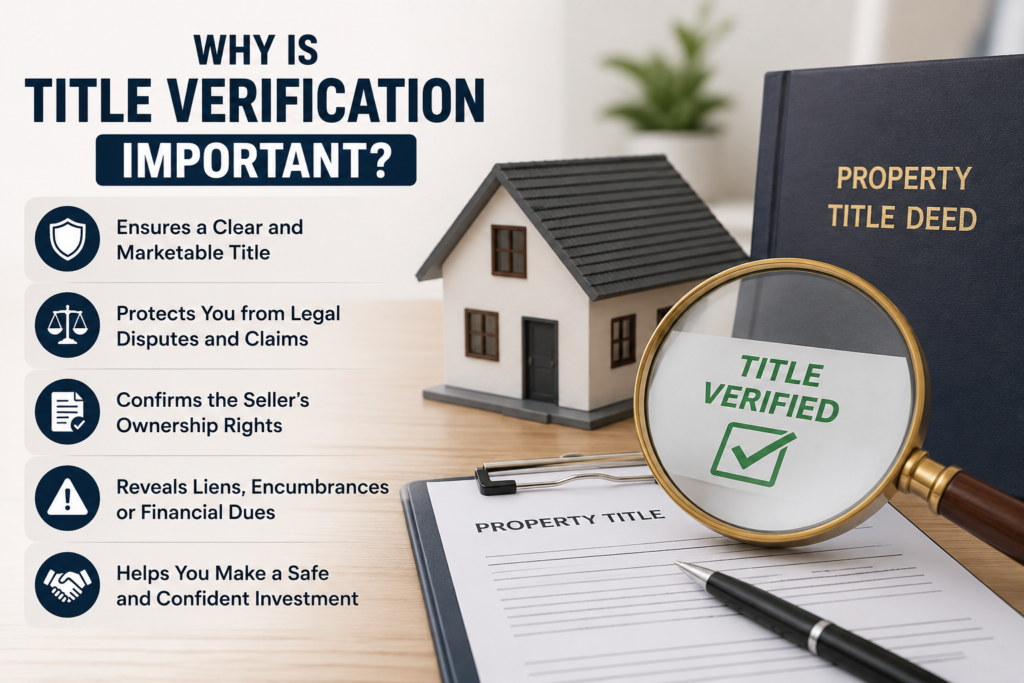
Why is title verification important?
If the seller does not have clear ownership, you could face problems after purchasing the property.
For example, another person may claim ownership of the property. There may also be inheritance issues or disputes between family members.
A property lawyer can conduct a title search and review the ownership chain before you proceed.
Pointer: Never pay a large amount simply because the seller says, “All documents are clear.” Ask to see the documents and get them independently verified.
2. Check for Encumbrances and Legal Disputes
An encumbrance can mean a legal or financial claim affecting a property. For example, a property may have a mortgage, charge, lien, or other claim.
Before purchasing, find out whether the property has any existing financial or legal burden.
You should also check whether there are known court cases or disputes involving the property.
What should you check?
Ask for relevant records and information concerning:
- Existing loans or mortgages
- Charges on the property
- Previous transactions
- Court cases
- Family disputes
- Government notices
- Property tax dues
- Utility dues
- Society or maintenance dues
- Other outstanding liabilities
The exact process for obtaining an encumbrance certificate or equivalent record depends on the state.
Why does this matter?
Imagine buying a property and discovering later that the previous owner had an unpaid loan secured against it. Resolving such an issue can be stressful and expensive.
This is why legal verification should happen before signing the final sale deed or making the full payment.
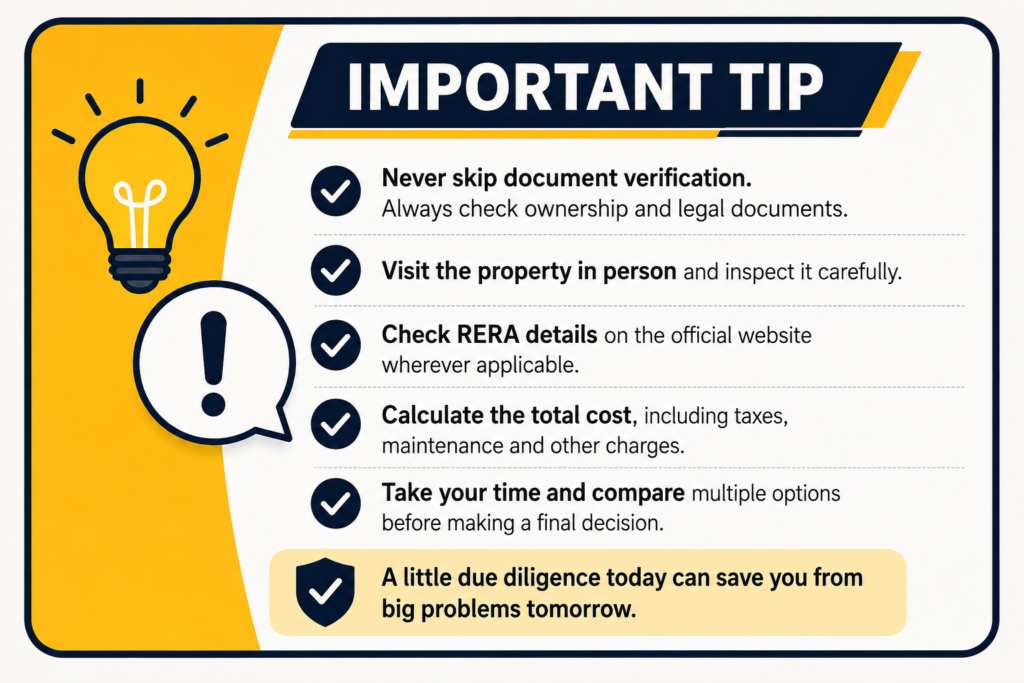
Important Tip
Ask the seller for written confirmation about outstanding dues, but do not depend only on their statement. Verify important information through appropriate government records and documents.
Pointer: If the seller is uncomfortable providing ownership or encumbrance-related documents, treat that as a warning sign.
3. Check RERA Registration
If you are purchasing a property in a real estate project, you should check whether the project is registered with the applicable Real Estate Regulatory Authority (RERA), where registration is required.
The Real Estate (Regulation and Development) Act, 2016 was introduced to regulate the real-estate sector, promote transparency, protect consumers, and establish mechanisms for dispute resolution.
What should you verify?
Check the applicable state RERA authority for information such as:
- Project registration number
- Promoter/developer details
- Project location
- Approved project information
- Completion-related information
- Project status
- Registered plans and disclosures
- Complaints or orders, where available
Do not rely only on a brochure or sales representative’s statement.
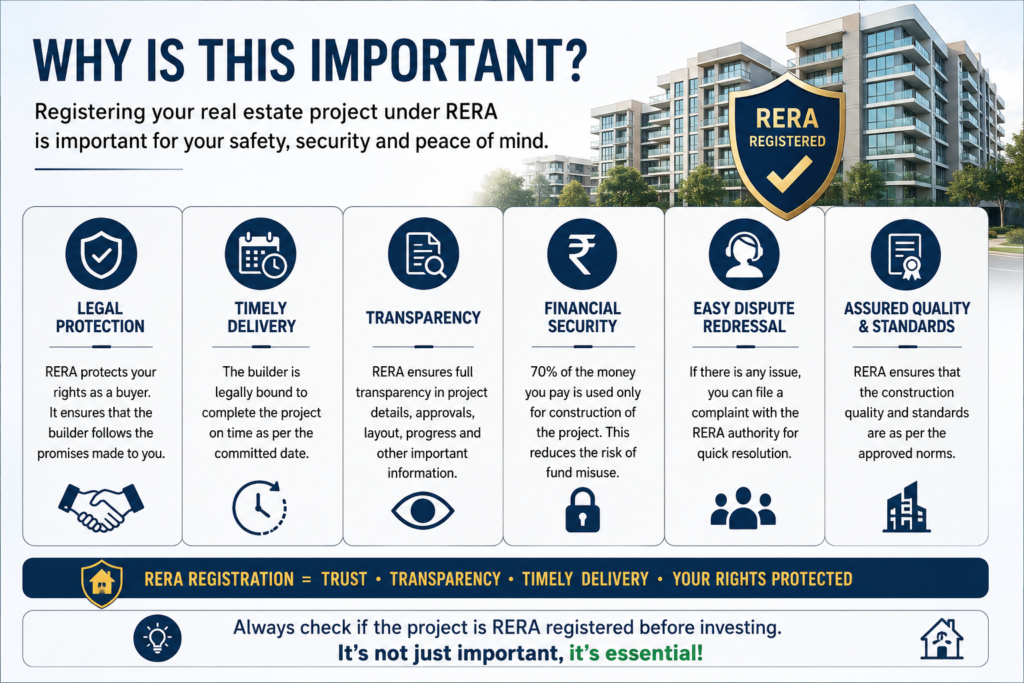
Why is RERA important?
RERA provides a regulatory framework for eligible real-estate projects and aims to improve transparency between developers and buyers.
However, RERA registration does not mean that you should skip your own legal and financial checks.
You should still verify the property’s title, approvals, specifications, agreement terms, payment schedule, and other important details.
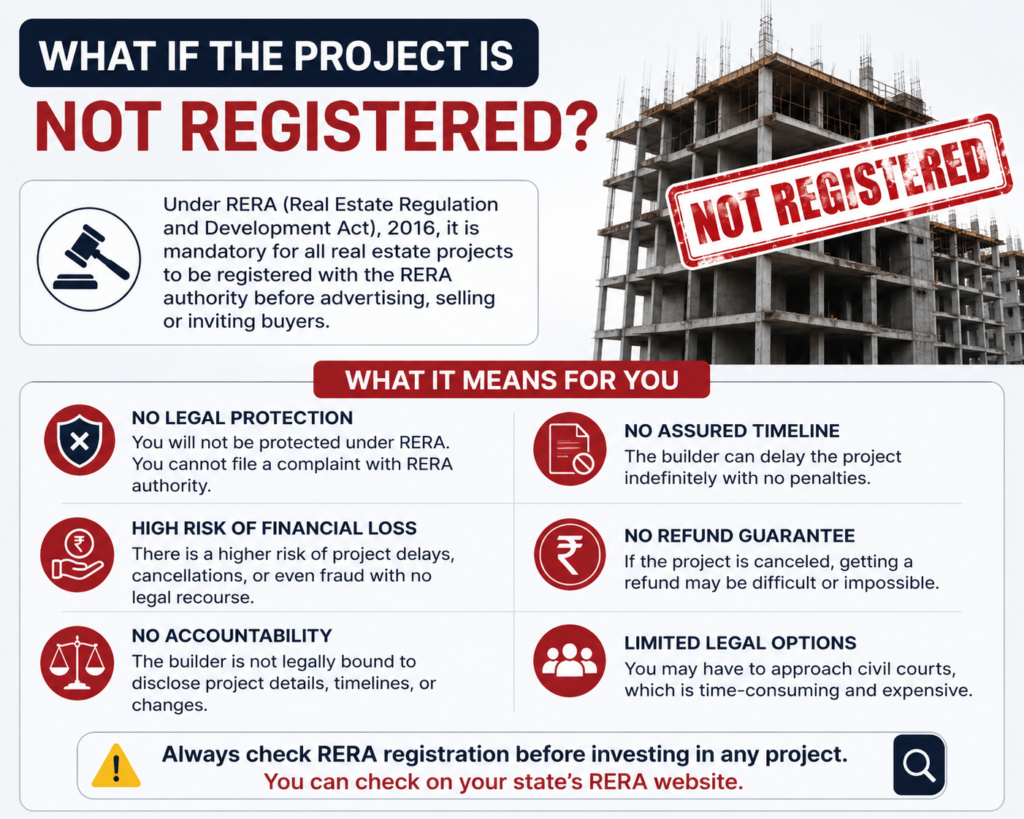
What if the project is not registered?
There can be legitimate situations where a project may not require registration under applicable law or may fall under an exemption. Therefore, do not automatically assume that every unregistered project is illegal.
Check the applicable state RERA rules and seek professional advice if necessary.
Pointer: Always compare what the builder promises with the information available in the official RERA records.
4. Confirm Land Use and Property Permissions
A property should be used for the purpose legally permitted by the relevant planning or local authority.
For example, land may have restrictions relating to residential, commercial, agricultural, industrial, or other uses.
Before purchasing, check whether the property can legally be used for the purpose you have in mind.
What should you verify?
Depending on the property, check:
- Land-use classification
- Layout approval
- Building plan approval
- Development permissions
- Zoning restrictions
- Completion certificate, where applicable
- Occupancy certificate, where applicable
- Local authority permissions
- Road access
- Any applicable development restrictions
The exact approvals depend on the state, city, property type, and stage of construction.
Why is this important?
Suppose you buy land believing you can build a commercial property on it, but the applicable planning rules permit only another use.
That could create serious problems.
Similarly, an apartment should be checked against the approved plans and applicable local requirements.
Pointer: Do not assume that a property can be used for any purpose simply because someone else is already using it that way.
5. Inspect the Property’s Physical Condition and Construction Quality
Legal documents are important, but you should also physically inspect the property.
A beautiful property can still have hidden problems.
If you are purchasing a ready-to-move-in house or an older apartment, carefully inspect its condition.
Check areas such as:
- Walls and ceilings
- Cracks
- Dampness
- Water leakage
- Plumbing
- Electrical wiring
- Doors and windows
- Flooring
- Kitchen fittings
- Bathroom fittings
- Water pressure
- Drainage
- Ventilation
- Natural light
- Parking area
- Lift condition
- Fire-safety arrangements
- Common areas
- Structural condition
For an older property, consider getting a qualified civil engineer or building professional to inspect it.
What about a new property?
For a new apartment or house, compare the actual property with:
- Approved plans
- Builder specifications
- Sale agreement
- Brochure
- Promised amenities
- Size and layout
Do not assume that every feature shown in a marketing brochure is automatically included in the final property.
Pointer: Visit the property more than once, preferably at different times of the day.

6. Research the Location and Surrounding Area
A property is not only about the building. Location can strongly affect your daily life and future resale or rental potential.
Before buying, research the neighbourhood carefully.
Check the following:
- Road connectivity
- Public transport
- Schools
- Hospitals
- Markets
- Banks and ATMs
- Shopping areas
- Offices and business centres
- Parks
- Restaurants
- Water supply
- Electricity supply
- Drainage
- Internet connectivity
- Traffic
- Noise levels
- Parking
- Safety and security
- Future infrastructure projects
Visit the location at different times, including morning and evening.
A quiet road at noon may become very busy during office hours.
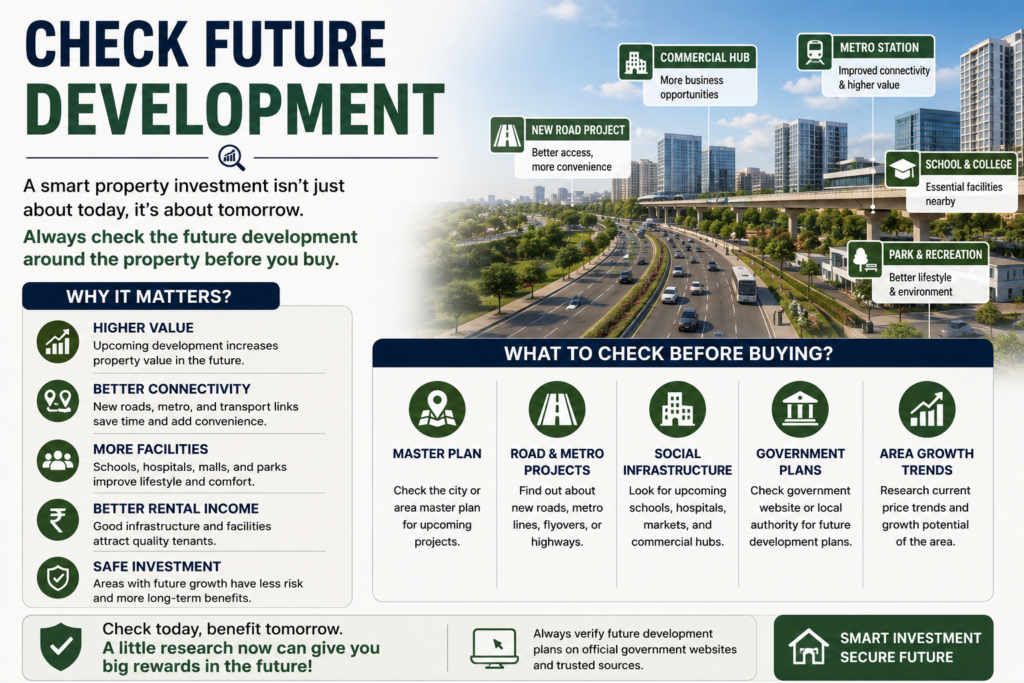
Check future development
Find out whether major roads, metro lines, commercial projects, industrial areas, or other infrastructure projects are planned nearby.
Future development can be beneficial, but some projects can also create noise, traffic, or environmental concerns.
Pointer: Talk to nearby residents. They can often tell you practical things that a property brochure will not mention.
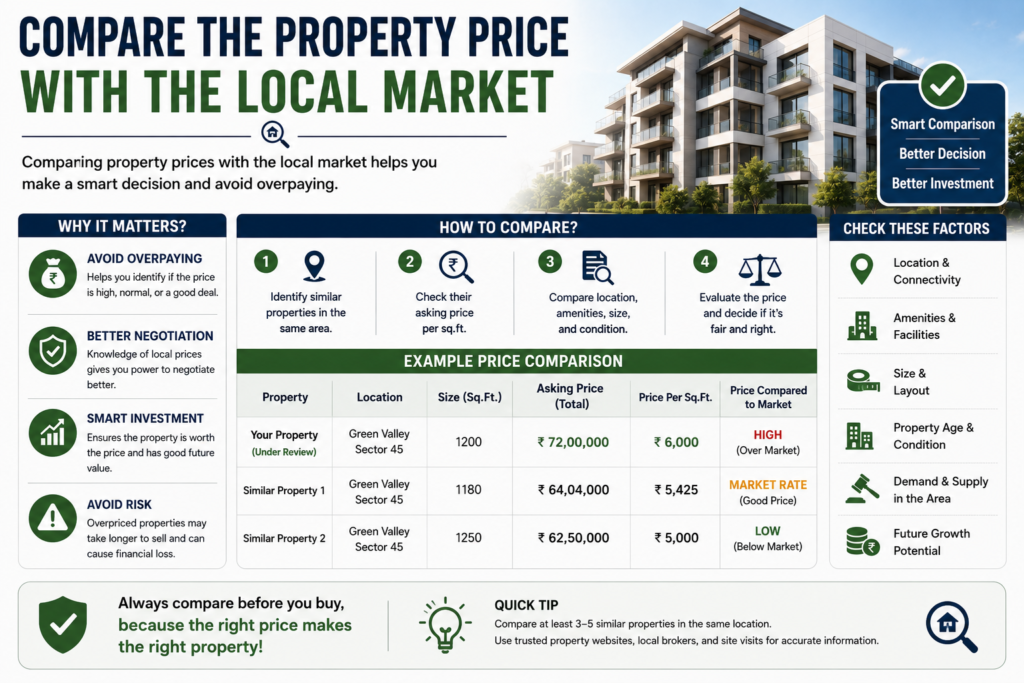
7. Compare the Property Price With the Local Market
Never buy a property only because the seller says it is a “special price.”
Before making an offer, research similar properties in the same locality.
Compare properties based on:
- Location
- Carpet area
- Built-up area
- Plot size
- Age of property
- Floor
- Parking
- Amenities
- Construction quality
- Road width
- Facing, where relevant
- Condition
- Nearby infrastructure
- Developer reputation
- Recent comparable transactions
Try to compare similar properties, rather than comparing completely different homes.
Ask yourself:
- Is the asking price reasonable?
- Are similar properties available at a lower price?
- Is the property priced higher because of genuine advantages?
- Are there expensive repairs required?
- Does the property have good resale potential?
- What rental income could realistically be expected?
Also remember that asking prices and actual transaction values can differ.
Government valuation or guideline values may also be relevant for stamp-duty purposes, and state-specific rules can apply. The Indian Stamp Act contains provisions dealing with stamp duty and valuation, while state laws can modify or supplement the applicable framework.
Pointer: Take your time before negotiating. A little market research can potentially save a significant amount of money.
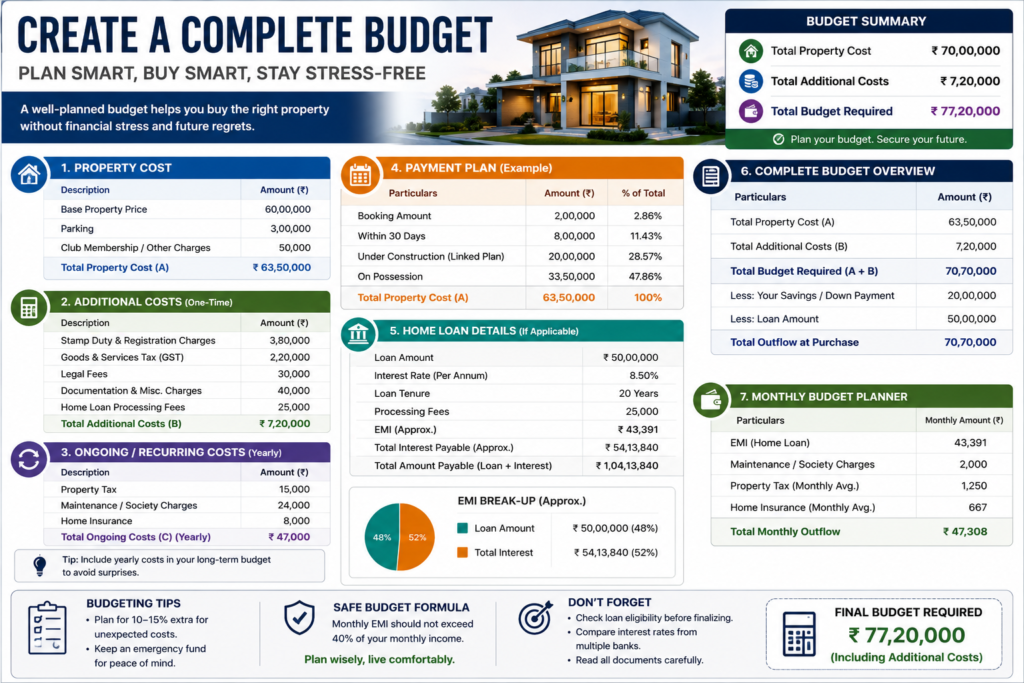
8. Calculate the Complete Cost of Buying the Property
One of the most common mistakes buyers make is looking only at the property’s sale price.
The actual cost can be much higher.
Additional expenses may include:
- Stamp duty
- Registration fee
- Brokerage
- Legal fees
- Home-loan processing charges
- Bank-related charges
- Property valuation charges
- Maintenance deposits
- Society charges
- Parking charges
- Utility connection charges
- Interior work
- Renovation costs
- Moving expenses
- Insurance
- Taxes or other applicable charges
The exact charges vary by state, property type, transaction structure, and applicable rules.
Registration and stamp-duty requirements should be checked with the relevant state authority before completing the transaction. The Registration Act, 1908 contains provisions concerning registration of certain documents relating to immovable property.
Create a complete budget
For example:
Property price + government charges + legal costs + loan costs + renovation + moving costs = Total buying cost
This gives you a much more realistic picture.
Pointer: Keep an emergency fund after buying the property. Do not spend every rupee of your savings on the purchase itself.
9. Check Home Loan and Financial Requirements Carefully
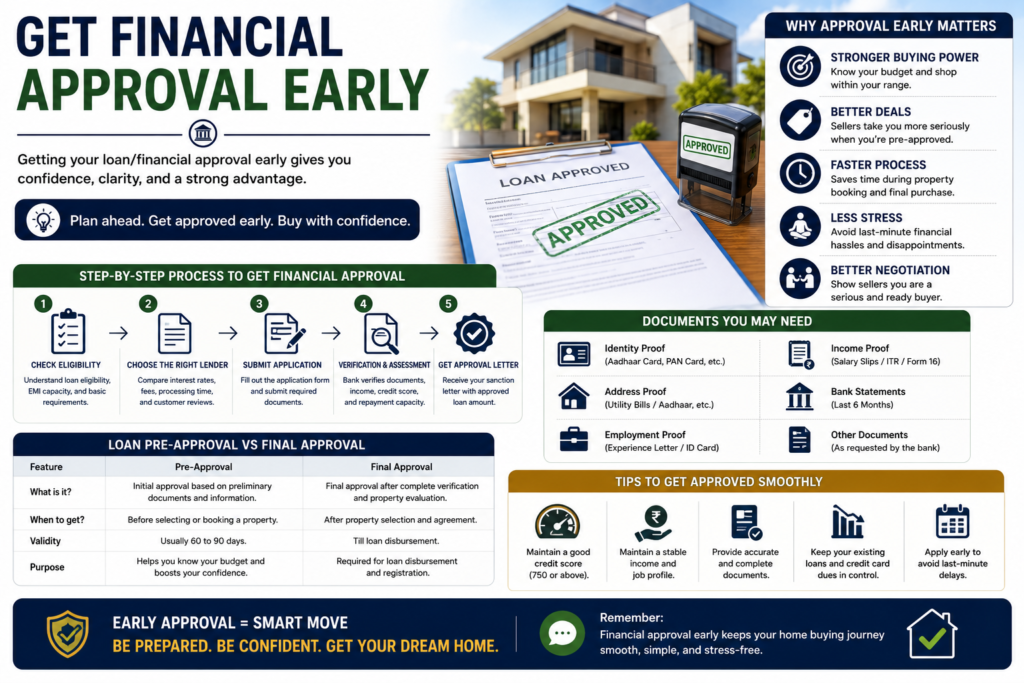
If you are planning to finance the property through a home loan, speak to lenders before finalising the purchase.
A bank’s willingness to lend can depend on factors such as:
- Your income
- Credit history
- Existing loans
- Age
- Employment/business profile
- Loan amount
- Property value
- Property documents
- Property location
- Legal and technical verification
Don’t focus only on the interest rate
Compare:
- Interest rate
- Loan tenure
- Processing fee
- Prepayment terms
- Other charges
- EMI
- Total interest payable
- Loan-to-value conditions
You should understand how much EMI you can comfortably afford.
Get financial approval early
A preliminary loan assessment can help you understand your budget before you start negotiating seriously.
However, loan approval should not be treated as a replacement for independent legal verification.
Pointer: A bank’s property verification is helpful, but you should still have your own legal review where appropriate.
10. Verify All Documents and Get Professional Advice
Before making the final payment, create a complete property-document checklist.
The documents will vary according to the property and state, but may include:
- Sale deed
- Previous title documents
- Encumbrance-related records
- Property tax receipts
- Approved building plan
- Completion certificate, where applicable
- Occupancy certificate, where applicable
- RERA information, where applicable
- Land-use documents
- Mutation/revenue records
- Possession documents
- Society documents, where applicable
- No-dues information
- Identity and authority documents of the seller
- Loan closure documents, if applicable
Why professional verification matters
Property transactions involve legal, financial, technical, and local regulatory issues.
A qualified property lawyer can review the legal documents and title.
A qualified engineer can inspect construction and structural concerns.
A financial professional or lender can help you understand financing and affordability.
Using professionals does not mean you cannot research the property yourself. It means you have additional protection when the transaction involves a large amount of money.
Do not rush the final payment
Never allow a seller or broker to pressure you with statements such as:
- “Pay today or someone else will buy it.”
- “The documents are being prepared.”
- “You can check everything after payment.”
- “This discount is available only for one hour.”
A genuine property transaction should allow reasonable time for due diligence.
Pointer: If something does not look right, pause the transaction and investigate before paying.
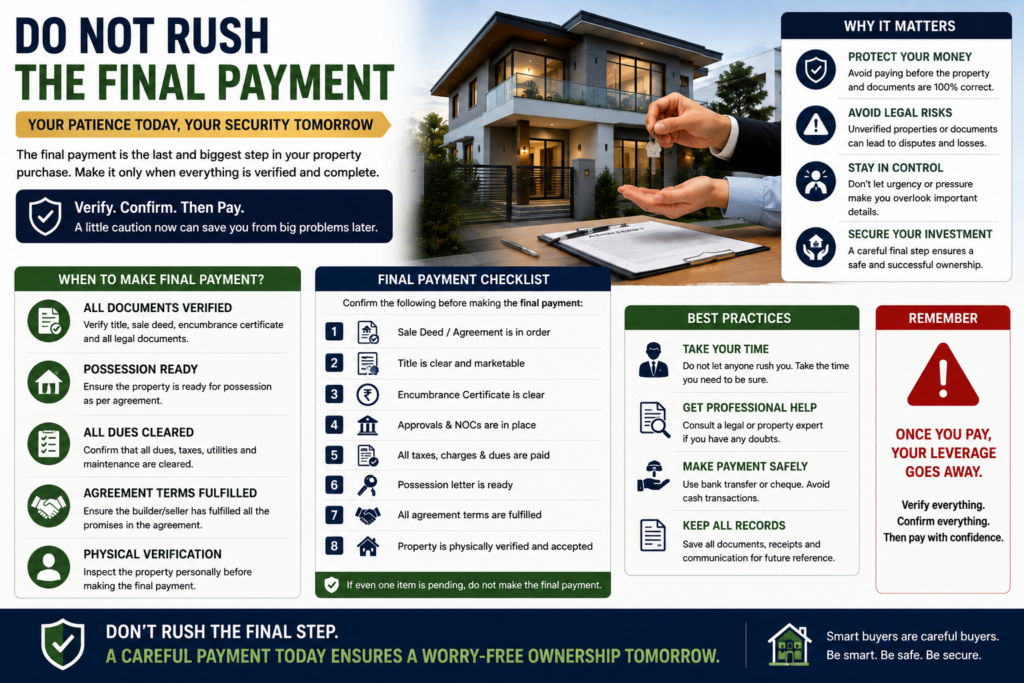
Bonus: Property Buying Checklist for First-Time Buyers
If you are buying property for the first time, save this checklist:
Legal Checklist
- Seller’s identity verified
- Ownership verified
- Title documents reviewed
- Encumbrance checked
- Legal disputes checked
- Property tax dues checked
- Required approvals verified
- Land use checked
- RERA registration checked where applicable
Physical Checklist
- Property physically inspected
- Construction quality checked
- Water leakage checked
- Electrical system checked
- Plumbing checked
- Parking checked
- Common areas checked
- Amenities verified
Financial Checklist
- Market price researched
- Property valuation understood
- Stamp duty estimated
- Registration charges estimated
- Brokerage considered
- Loan eligibility checked
- EMI calculated
- Emergency fund maintained
Location Checklist
- Road connectivity checked
- Public transport checked
- Schools nearby checked
- Hospitals nearby checked
- Markets checked
- Water and electricity checked
- Traffic and noise checked
- Future development researched
Common Mistakes to Avoid When Buying Property in India
Even careful buyers can make mistakes. Here are some common ones to avoid.
1. Buying only because of a low price
A cheap property may have legal, construction, location, or documentation problems.
Always understand why the property is cheaper.
2. Trusting verbal promises
If an important promise is made by a seller or developer, ask whether it is included in the agreement or relevant written documents.
3. Ignoring small document differences
Names, plot numbers, area measurements, addresses, survey numbers, and other details should be checked carefully.
Even small inconsistencies deserve attention.
4. Skipping physical inspection
Photos and videos cannot show everything.
Visit the property personally.
5. Forgetting additional costs
The sale price is not always the final amount you will spend.
Calculate the complete cost before deciding.
6. Rushing because of pressure
Buying a property is a major decision. Avoid making an irreversible financial commitment simply because someone creates urgency.
Why Professional Verification Matters
Buying property involves much more than finding a beautiful house at a good price.
A property lawyer can help you understand ownership and legal documents.
A civil engineer or qualified technical professional can identify physical or construction-related concerns.
A financial professional or lender can help you understand the affordability and financing side.
A real estate professional with good local knowledge can also help you understand market conditions, neighbourhoods, and comparable properties.
The goal is not to make the process unnecessarily complicated. The goal is to reduce avoidable risks before you invest your money.
Frequently Asked Questions
What is the first thing to check before buying property in India?
The first major check should be the ownership and legal title of the property. Confirm that the seller has the legal right to sell it and review the relevant ownership documents.
Is RERA registration compulsory for every property?
No. RERA requirements depend on the type of project and applicable exemptions and rules. For a property in a real-estate project, check the relevant state RERA authority to determine whether registration is required.
Should I hire a property lawyer?
For a major property purchase, independent legal review can be very useful, especially when there are complicated title histories, inherited properties, land issues, multiple owners, loans, disputes, or unusual documentation.
What is an encumbrance on a property?
An encumbrance generally refers to a legal or financial claim or burden affecting a property. Examples can include certain mortgages, charges, or other claims.
Should I inspect a property before buying it?
Yes. A physical inspection can help identify problems such as dampness, cracks, water leakage, poor construction, electrical issues, plumbing problems, and other defects.
How do I know whether a property is fairly priced?
Compare similar properties in the same locality while considering size, age, condition, location, amenities, parking, construction quality, and other relevant factors.
What additional costs should I consider?
Depending on the transaction, you may need to consider stamp duty, registration fees, brokerage, legal fees, loan-related costs, maintenance deposits, interiors, renovation, moving expenses, and other applicable charges.
Can a home loan guarantee that a property is legally safe?
No. A lender’s legal and technical checks are useful, but buyers should not treat loan approval as a substitute for independent due diligence.
Final Takeaway
Buying a property in India can be exciting, but it is also a decision that requires careful research.
The most important rule is simple:
Do not buy a property only because you like it. Buy it after you verify it.
Before signing the final documents, check the property title, ownership, encumbrances, disputes, RERA status where applicable, land use, approvals, construction quality, location, market price, complete cost, financing, and documents.
Take your time. Ask questions. Compare properties. Keep written records. And when the transaction is significant or complicated, seek advice from qualified legal, technical, and financial professionals.
A few days spent on proper due diligence can help protect an investment that may affect your finances for many years.
One-Page Summary: 10 Things to Check Before Buying Property
1. Ownership & Title
Make sure the seller has a clear legal right to sell the property.
2. Encumbrances & Disputes
Check for loans, charges, legal claims, unpaid dues, and disputes.
3. RERA Registration
For applicable real-estate projects, verify registration and project details with the relevant state RERA authority.
4. Land Use & Approvals
Confirm that the property has the required permissions and can legally be used for your intended purpose.
5. Construction Quality
Inspect the building, plumbing, electrical systems, walls, ceilings, fittings, and common areas.
6. Location
Research connectivity, schools, hospitals, markets, transport, utilities, traffic, and future development.
7. Market Price
Compare similar properties before accepting the asking price.
8. Total Cost
Include stamp duty, registration, brokerage, legal fees, loan costs, interiors, maintenance, and other expenses.
9. Home Loan
Check your loan eligibility, EMI, interest rate, tenure, and other charges.
10. Professional Verification
Get important legal, technical, and financial matters checked before making the final commitment.
Sources & Trust References
For legal and regulatory information, buyers should verify current requirements with official authorities. The Real Estate (Regulation and Development) Act, 2016 is available through India Code, as are the Registration Act, 1908 and Indian Stamp Act, 1899.
Disclaimer: This article is for general educational information and is not a substitute for legal, financial, tax, architectural, engineering, or other professional advice. Property laws, stamp duty, registration fees, RERA requirements, approvals, and local rules can vary by state and may change. Always verify the latest requirements with the relevant authority and qualified professionals before purchasing a property.